Tue, Jun 23 2026
Raju Karn
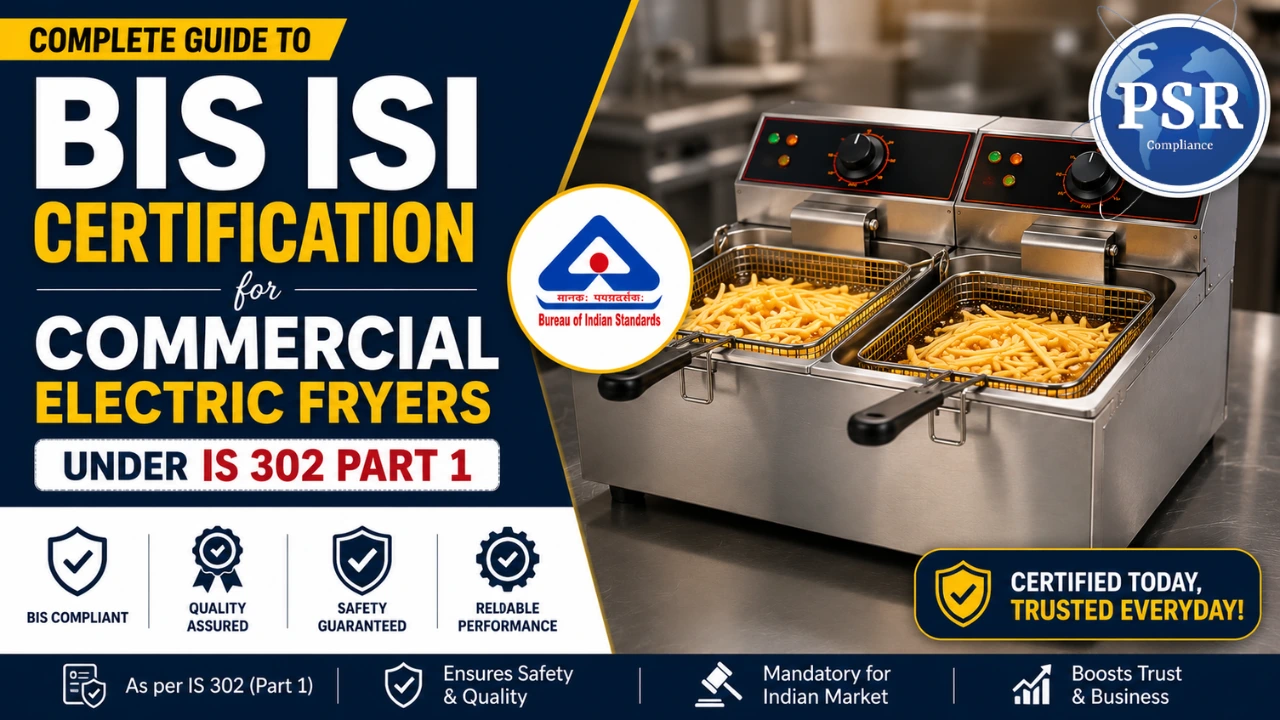
BIS ISI Certification for Commercial Electric Fryers Under IS 302 Part 1
Commercial electric fryers are everywhere in India’s food business. Quick-service restaurants use them. Hotels use them. Cloud kitchens rely on them. Cafes, bakeries, canteens, food courts, sweet shops, catering companies, and institutional kitchens depend on them every day.
But under the QCO for household, commercial, and similar electrical appliances, commercial electric fryers are not just kitchen equipment. They are regulated products that require BIS ISI certification and proper compliance planning.
The QCO includes commercial electric fryers and requires covered products to conform to IS 302 Part 1: 2024 and carry the BIS Standard Mark under a valid BIS licence. For general enterprises, the implementation date mentioned is 1 October 2026, while small and micro enterprises may have extended timelines. However, commercial kitchen equipment suppliers should not wait until the deadline.
They should prepare early.
Why Commercial Electric Fryers Need Special Attention
Commercial fryers are high-risk, high-usage appliances. Unlike domestic appliances, they run for long hours in demanding environments. A single unit may operate continuously in a busy kitchen with multiple staff members handling it.
They combine:
● Electricity
● High heat
● Hot oil
● Metal surfaces
● Mechanical controls
● Continuous operation cycles
This makes safety critical.
A failure in a commercial fryer can lead to:
⚠ Electric shock risks
⚠ Fire hazards
⚠ Oil overheating
⚠ Equipment shutdown
⚠ Operational disruption in restaurants or hotels
In real business terms, the impact is serious. A restaurant may stop service. A cloud kitchen may miss orders. A catering business may fail during an event. A hotel kitchen may face guest complaints.
This is why BIS certification is not just regulatory compliance—it is a safety and business continuity requirement.
Where Commercial Electric Fryers Are Used
| Sector | Usage |
|---|---|
| Restaurants | Fast frying operations in QSR and dine-in kitchens |
| Hotels | Large-scale food preparation for guests |
| Cloud kitchens | High-volume order fulfillment |
| Cafes and bakeries | Snacks and menu preparation |
| Catering companies | Event-based bulk cooking |
| Food courts | Continuous multi-vendor cooking |
| Sweet shops | Frying sweets and snacks |
| Institutional kitchens | Schools, hospitals, canteens |
These environments demand durability, safety, and consistency. That is why compliance matters at every level.
Who Needs BIS ISI Certification for Commercial Electric Fryers?
While the manufacturer is usually the primary applicant, compliance responsibility extends across the supply chain.
You should prepare for BIS certification if you are:
➝ An Indian manufacturer of commercial electric fryers
➝ A foreign manufacturer exporting fryers to India
➝ An importer of restaurant kitchen equipment
➝ A hotel and restaurant equipment supplier
➝ A brand owner selling fryers under your own brand
➝ A private-label kitchen equipment company
➝ A distributor supplying commercial fryers
➝ An e-commerce seller listing commercial fryers
➝ A cloud kitchen setup consultant
➝ A central kitchen procurement vendor
➝ A service company bundling equipment with installation
Many businesses assume certification is only the factory’s responsibility. In reality, anyone involved in branding, importing, or selling is exposed to compliance risk.
Industries and Ecosystems Affected
Commercial electric fryers are part of a large ecosystem. The impact of BIS compliance extends across:
- ▪ Restaurant equipment manufacturing
- ▪ Hotel kitchen procurement
- ▪ Quick-service restaurant chains
- ▪ Cloud kitchen infrastructure
- ▪ Catering equipment supply
- ▪ Institutional canteens
- ▪ Bakery and café operations
- ▪ Food court vendors
- ▪ Supermarket hot-food counters
- ▪ Commercial kitchen design firms
- ▪ Import trading companies
Because of this wide distribution chain, one non-compliant product can affect multiple stakeholders. Dealers may hesitate to sell it. Buyers may reject it. Service partners may avoid supporting it.
BIS certification creates a shared trust framework across this ecosystem.
Related Products That Should Also Be Checked
Businesses dealing with commercial fryers often sell a wider range of kitchen equipment. Compliance should not be limited to a single product.
Related products may include:
▫ Commercial electric cooking ranges
▫ Commercial ovens
▫ Commercial griddles
▫ Boiling pans
▫ Grillers and toasters
▫ Food warmers
▫ Bain-marie units
▫ Dishwashing machines
▫ Kitchen exhaust hoods
▫ Vacuum packaging machines
Most kitchen equipment suppliers operate as full-range vendors. That means compliance must be mapped across the entire catalogue, not just one product line.
Why Early BIS Certification Matters
Many companies delay certification thinking the deadline is far away. But certification is not controlled by sales timelines.
It depends on:
➤ Testing lab availability
➤ Factory audit readiness
➤ Document verification
➤ Model grouping clarity
➤ BIS query resolution
➤ Packaging and labeling updates
➤ Commercial fryers also come in multiple variants:
➤ Oil capacity differences
➤ Power ratings
➤ Single or dual tank systems
➤ Control variations
➤ Structural design differences
Each variation may impact certification scope.
Delays can result in:
• Failed test results
• Redesign of components
• Packaging rework
• Shipment delays
• Lost tenders or restaurant contracts
• Dealer stocking restrictions
Early preparation prevents these issues.
Documents and Preparation Required
A manufacturer of commercial electric fryers typically needs:
→ Company registration documents
→ Factory address proof
→ Manufacturing process flow
→ Product specification sheets
→ Model list with ratings
→ Brand ownership documents
→ Component details
→ Quality control plan
→ Testing equipment details
→ Manufacturing machinery list
→ Label and rating plate design
→ User manuals and safety instructions
→ Authorized signatory documents
→ Indian representative documents (for foreign manufacturers)
BIS certification is not just a one-time test. It is an ongoing compliance system.
How a BIS Certification Consultant Helps
A BIS certification consultant plays a key role in simplifying the process.
For commercial electric fryers, a consultant helps with:
- 🗹 Checking QCO coverage
- 🗹 Identifying applicable standards (IS 302 Part 1: 2024)
- 🗹 Preparing documentation
- 🗹 Structuring model grouping
- 🗹 Coordinating product testing
- 🗹 Reviewing labels and markings
- 🗹 Preparing for factory inspection
- 🗹 Filing BIS application
- 🗹 Handling queries and clarifications
- 🗹 Coordinating licence approval
- 🗹 Supporting post-certification compliance
For foreign manufacturers, consultants bridge communication between overseas factories, Indian representatives, and BIS authorities.
For importers, they reduce confusion by standardizing documentation requirements.
What Buyers Expect After Compliance Becomes Mandatory
Once enforcement becomes strict, buyers will increasingly demand compliance proof.
Typical buyer requirements include:
- BIS licence details
- Certification status confirmation
- Product marking verification
- Compliance documents for tenders
- Marketplace approval documentation
This applies to:
- Restaurant chains
- Hotel procurement teams
- Government canteens
- Online marketplaces
- Distributors and dealers
Compliance becomes part of the buying decision, not an optional detail.
Pre-Compliance Checklist for Sellers
Before the mandatory date, sellers and distributors should ensure:
- ▪ Product is covered under QCO
- ▪ Manufacturer has applied for BIS certification
- ▪ Model list is clearly defined
- ▪ Certification timeline is known
- ▪ BIS Standard Mark will be applied
- ▪ Packaging is updated for compliance
- ▪ Existing stock status is reviewed
- ▪ Marketplace documentation is ready
If suppliers cannot answer these questions clearly, it is a risk indicator.
Why BIS Certification Strengthens Business Position
In the commercial kitchen equipment market, many products look similar in terms of price, power, and features. BIS certification adds a strong differentiator.
A certified fryer offers:
- ➜ Verified safety standards
- ➜ Regulatory compliance assurance
- ➜ Stronger institutional acceptance
- ➜ Easier procurement approvals
- ➜ Improved brand credibility
- ➜ Reduced buyer hesitation
In B2B markets, this often becomes a deciding factor.
A failed fryer in a restaurant can cost far more than the savings from buying a cheaper uncertified product. Certification helps communicate reliability and long-term value.
Final Word
Commercial electric fryers are critical appliances in India’s food service industry. Under the QCO for household, commercial, and similar electrical appliances, they are also regulated products that require BIS ISI certification under IS 302 Part 1: 2024.
For manufacturers, importers, distributors, and brand owners, this is not just a legal requirement—it is a market access condition, a safety assurance system, and a business continuity safeguard.
The 1 October 2026 implementation date for general enterprises should be treated as a planning deadline, not a warning date.
Businesses that prepare early will continue selling without disruption. Those that delay may face testing delays, documentation gaps, and lost business opportunities.
If commercial electric fryers are part of your catalogue, the right time to start is now—map your models, verify compliance, prepare documentation, and align your BIS certification strategy before the market demands it.
🔧 Get Expert Help with BIS ISI Certification for Commercial Electric Fryers
Need assistance with BIS ISI Certification under IS 302 (Part 1) for commercial electric fryers? PSR Compliance offers complete support—from documentation and application filing to testing coordination and final certification—ensuring a smooth and hassle-free approval process.
👉 Avoid delays, product rejections, and compliance risks with expert guidance.
📞 8796104190
📧 support@psrcompliance.com
FAQs – BIS ISI Certification for Commercial Electric Fryers
Is BIS ISI Certification mandatory for commercial electric fryers?
Yes, it is mandatory under the Quality Control Order (QCO) in India for safety compliance.
Which standard applies to electric fryers?
Commercial electric fryers must comply with IS 302 (Part 1) and relevant fryer-specific requirements.
What tests are conducted for certification?
Key tests include electric shock protection, overheating, moisture resistance, insulation, and mechanical strength.
How long does the BIS certification process take?
It usually takes 12 to 26 weeks, including testing and approval.
Can multiple fryer models be certified together?
No, each model with different specifications requires separate testing and approval.
What is the process to get the ISI Mark?
Testing → Application → Factory Inspection → License Grant.