Tue, Jun 23 2026
Raju Karn
Electric Food Processors and BIS ISI Certification: What Businesses Need to Know Before 1 October 2026
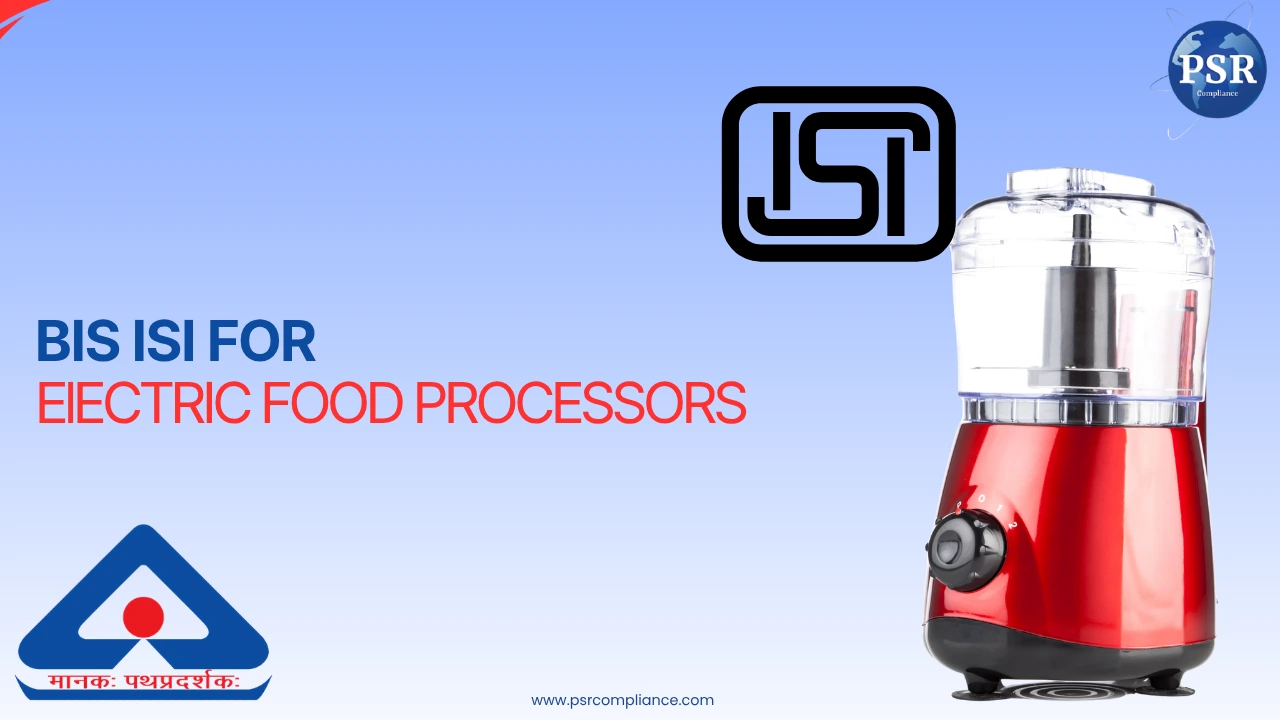
If you manufacture, import, sell, or private-label electric food processors in India, the next big compliance deadline should already be on your desk. The Safety of Household, Commercial and Similar Electrical Appliances QCO brings many electrical appliances under mandatory BIS ISI certification. Electric food processors are one of the important BIS products covered in the list. From 1 October 2026, general enterprises dealing in these products will need to make sure their appliances conform to IS 302 Part 1: 2024 and bear the BIS Standard Mark under a valid BIS licence. For a buyer, a food processor is just a kitchen product. For a brand, it is a business line. For BIS, it is an electrical appliance that must meet safety requirements before it can be sold in the Indian market.
That is the difference most businesses miss.
This is not only a technical certification. It is a market access document. Without it, your product may be blocked from legal sale, your stock may get stuck, your distributors may pause orders, and online marketplaces may start asking for valid certification proof.
Why electric food processors are a serious BIS compliance product
Electric food processors are used in homes, cloud kitchens, small cafes, restaurants, catering units, hostels, bakeries, food startups, and commercial kitchens. The product looks simple from outside, but it includes electrical motors, blades, switches, jars, wiring, heating or control parts in some models, and moving components that can create real safety risk if the product is poorly designed.
That is why BIS certification matters. A food processor may create risks such as electric shock, overheating, poor insulation, unsafe moving parts, weak construction, low-quality cords, unstable jars, sharp rotating blades, or failure during continuous use. When a product is used daily in Indian kitchens, the safety expectation becomes higher.
BIS ISI certification helps prove that the appliance has been tested as per the applicable Indian Standard and that the manufacturer has a controlled production system to maintain consistent quality.
For business owners, this means two things.
First, BIS certification protects the customer. Second, BIS certification protects your market.
If your competitor gets BIS certification early and you wait until the last few months before the deadline, they can use compliance as a sales advantage. Dealers, distributors, institutional buyers, and e-commerce platforms prefer products that are already ready for regulation.
Who needs BIS ISI certification for electric food processors?
BIS ISI certification is mainly needed by the manufacturer. But in real business, many other people in the supply chain are affected.
You should prepare for BIS certification if you are :
• An Indian manufacturer of electric food processors
• A foreign manufacturer exporting food processors to India
• An importer bringing food processors into India
• A brand owner selling food processors under its own brand name
• A private-label seller sourcing from another factory
• An OEM or ODM supplier making food processors for Indian brands
• A distributor dealing with certified and uncertified stock
• An e-commerce seller listing electric food processors on online marketplaces
• A kitchen appliance startup launching its first product range
• A large retail chain selling appliances under a store brand
Many businesses think BIS is only the factory’s problem. That is risky thinking.
If you sell the product under your brand, your customers, dealers, marketplace partners, and regulators will ask you about certification. If the product is imported, the foreign manufacturer may need BIS registration and factory inspection before the product can legally carry the Standard Mark.
Which sectors are affected?
Electric food processors are not limited to home appliance companies. The QCO can affect a wide chain of sectors.
The main affected sectors include :
- Kitchen appliance manufacturing
- Consumer electrical goods
- Food processing equipment
- Retail and wholesale appliance distribution
- E-commerce and direct-to-consumer brands
- Hotel, restaurant, and catering equipment supply
- Cloud kitchen equipment supply
- Institutional kitchen procurement
- Export and import trading
- Private-label product sourcing
This is why the topic is commercial, not just informational. A single BIS compliance delay can disturb product launch, working capital, import planning, dealer commitments, and seasonal sales.
For example, if a brand plans to launch a food processor before Diwali 2026, it cannot treat BIS certification as a last-minute paperwork task. Testing, documentation, factory audit, sample submission, application review, marking approval, and licence grant can take time. If the first test fails, the timeline becomes longer.
Which products may fall close to this category?
| Related Kitchen Appliance | Potential Relevance to BIS ISI Certification |
|---|---|
| Electric bean slicers | May fall under related food preparation equipment categories. |
| Electric can openers | Should be evaluated for applicable BIS requirements. |
| Electric centrifugal juicers | Commonly sold alongside food processors and may require separate compliance assessment. |
| Electric citrus-fruit squeezers | May be covered under related kitchen appliance standards. |
| Electric coffee mills | Requires verification of applicable BIS standards and certification obligations. |
| Electric cream whippers | Should be assessed for regulatory coverage. |
| Electric egg beaters | Frequently included in kitchen appliance portfolios and may require compliance review. |
| Electric grain grinders | May fall under food processing equipment categories subject to BIS requirements. |
| Electric graters | Requires evaluation against relevant product standards. |
| Electric churns | May need separate certification assessment depending on product specifications. |
| Electric ice-cream machines | Could be covered by applicable kitchen appliance standards. |
| Electric knives | Requires review of relevant BIS regulations and standards. |
| Electric noodle makers | May require certification depending on product design and usage. |
| Electric potato peelers | Should be checked for applicable compliance requirements. |
| Electric shredders | May fall within related food preparation appliance categories. |
| Electric sieving machines | Requires assessment under relevant BIS standards. |
| Slicing machines | Often used in food preparation and may require certification review. |
| Low-speed food grinding machines | May be covered under food processing appliance regulations. |
This matters because one company may sell several products under one kitchen appliance catalogue. You should not check only one model. You should map the full product range and identify which models need BIS ISI certification under the QCO.
This is where a BIS certification consultant can save real money. The consultant does not only file an application. A good consultant first checks product coverage, applicable standard, model grouping, factory readiness, test requirements, and documentation gaps.
Why this certification has direct business value
Many companies treat BIS certification like a forced government cost. That is the wrong way to look at it.
For electric food processors, BIS ISI certification can support business in five clear ways.
▸ First, it protects your legal selling position. Once mandatory implementation begins, products covered by the QCO must follow the requirement. Selling without the required BIS mark can create penalties and enforcement risk under the BIS framework.
▸ Second, it protects your distribution network. Dealers do not want dead stock. If they suspect your product may become non-compliant, they may reduce orders before the deadline.
▸ Third, it improves trust. A food processor is used around food, water, electricity, and sharp blades. A recognized safety mark gives confidence to customers and institutional buyers.
▸ Fourth, it helps online sales. Marketplaces are becoming stricter about compliance documents. A valid BIS licence can support smoother listing and fewer product takedown risks.
▸ Fifth, it strengthens your tender and B2B position. Hotels, catering companies, hostels, government buyers, and organized retailers often prefer certified products because they reduce procurement risk.
In simple words, BIS certification is not only a rule. It is a sales support tool.
What documents are usually needed?
The exact document list depends on whether the applicant is an Indian manufacturer or a foreign manufacturer. But generally, businesses should prepare :
→ Business registration documents
→ Factory address proof
→ Manufacturing process details
→ Product details and model list
→ Brand details
→ Test reports, where applicable
→ Quality control documents
→ Manufacturing machinery list
→ Testing equipment list
→ Authorized signatory details
→ Trademark or brand authorization, where required
→ Nomination details for Indian representative, if the manufacturer is foreign
Document mismatch is one of the most common reasons for delay. A small difference in company name, factory address, brand spelling, model number, or product rating can slow the application.
This is why you should not wait until September 2026.
What should manufacturers do before applying?
Before filing for BIS ISI certification, the manufacturer should do a technical readiness check.
Start with the product label. Check voltage, wattage, frequency, model number, manufacturer details, country of origin, warnings, and rating information.
Then check the construction. Food processors should have proper insulation, safe wiring, suitable motor protection, stable jars, safe blade assembly, correct material selection, and proper controls.
Next, check factory quality control. BIS certification is not only about one sample passing a lab test. The factory should be able to produce the same safe product again and again.
Finally, check product family and model grouping. If you have multiple models with different capacities, wattage, accessories, motor types, or body designs, you need to understand how they will be handled in certification.
A weak application may be filed quickly, but it will not move quickly.
Why hire a BIS ISI certification consultant?
Technically, a manufacturer can try to manage BIS certification by itself. Practically, many businesses lose time because they do not understand the full process.
A BIS consultant helps with :
🗹 Product category checking
🗹 Standard applicability
🗹 Application preparation
🗹 Document review
🗹 Model grouping strategy
🗹 Lab coordination
🗹 Factory inspection readiness
🗹 Communication with BIS
🗹 Label and marking guidance
🗹 Renewal and post-licence compliance support
For importers and foreign manufacturers, the need becomes even stronger. Foreign factory applications often require careful coordination between the overseas plant, Indian representative, testing process, documentation, and BIS communication.
If your product launch depends on certification, expert handling is not a luxury. It is risk control.
The deadline is not far for business planning
1st October 2026 may look far away, but appliance businesses work with long cycles. Product development, sourcing, tooling, packaging, import orders, distributor commitments, festive inventory, and marketplace listings are planned months in advance.
If you start late, you may face :
⚠ Testing delays
⚠ Failed sample correction
⚠ Factory audit gaps
⚠ Document mismatch
⚠ Brand authorization issues
⚠ Import stock blockage
⚠ Dealer order cancellation
⚠ Product launch delay
The better approach is simple. Map your product range now. Identify food processor models. Check whether related kitchen appliances are also covered. Prepare documents. Test early. Apply early. Keep your market ready before the QCO becomes mandatory for your business category.
Final word
Electric food processors are no longer just another kitchen appliance in a product catalogue. Under the QCO for household, commercial, and similar electrical appliances, they are part of a regulated BIS product group.
For manufacturers, importers, private-label brands, and sellers, BIS ISI certification under IS 302 Part 1 - 2024 is becoming a direct business requirement. It can decide whether your product moves smoothly through the Indian market or gets stuck at the exact time when demand is high. The companies that prepare early will have a clear advantage. They will be ready for distributors, marketplaces, institutional buyers, and regulatory checks. The companies that delay may spend more time explaining than selling.
If electric food processors are part of your business, start the BIS certification process now. Compliance is not only about avoiding penalties. It is about keeping your product sellable, trusted, and ready for growth.
Get Expert Help with BIS ISI Certification for Electric Food Processors
Need assistance with BIS ISI Certification for Electric Food Processors, product testing, documentation, factory compliance, or BIS licence approvals? PSR Compliance provides end-to-end support to help manufacturers, importers, and brands obtain BIS certification efficiently and in compliance with regulatory requirements.
👉 Avoid certification delays, application errors, and compliance risks with expert guidance.
📞 8796104190
📧 support@psrcompliance.com
FAQs
Is BIS Certification mandatory for electric food processors?
Yes. Electric food processors covered under the QCO must have BIS ISI Certification before they can be sold in India.
Which standard applies to electric food processors?
Electric food processors must comply with IS 302 (Part 1): 2024 for safety requirements.
What is the BIS certification process for food processors?
The process includes application submission, product testing, factory inspection, and BIS licence approval.
Do imported electric food processors require BIS certification?
Yes. Foreign manufacturers must obtain BIS certification under the FMCS scheme before exporting to India.
Can multiple food processor models be certified under one licence?
It depends on the product specifications and model variations. Separate testing may be required for different variants.
How long is a BIS licence valid?
A BIS licence is generally valid for two years and must be renewed before expiry.
Who needs BIS certification for electric food processors?
Manufacturers are required to obtain certification, while importers and brand owners must ensure compliance before selling the product.
What documents are required for BIS certification?
Common documents include business registration, factory details, product specifications, quality control records, and authorized signatory details.
Why is BIS certification important for electric food processors?
It helps ensure product safety, regulatory compliance, and smooth access to the Indian market.
When should businesses start the BIS certification process?
Businesses should start early to avoid testing delays, documentation issues, and certification bottlenecks before the compliance deadline.