Tue, Jun 23 2026
Raju Karn
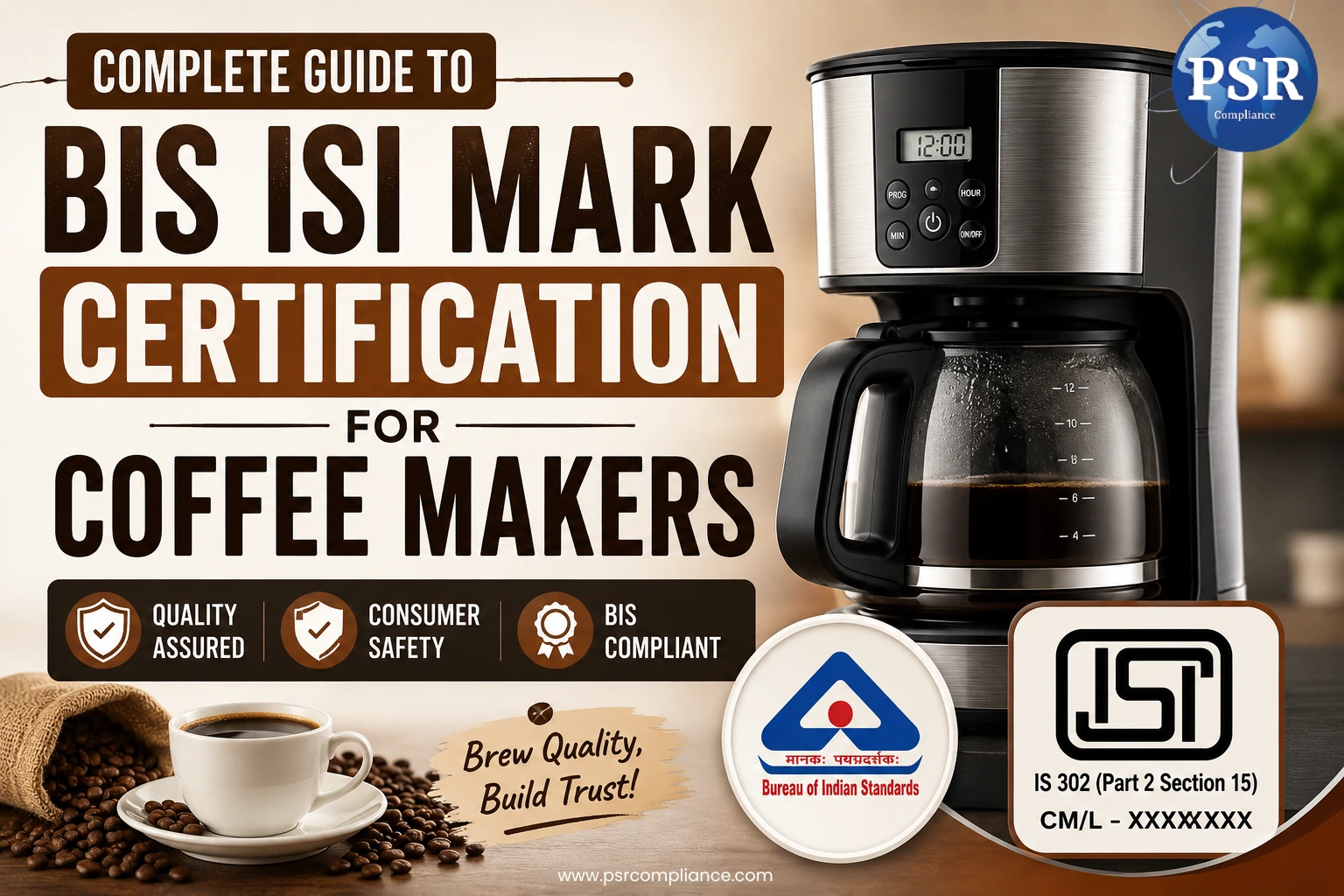
BIS ISI Certification for Electric Coffee Makers Under the 90 Electrical Appliances QCO
India’s coffee culture is growing fast. Homes, offices, cafes, hotels, co-working spaces, bakeries, restaurants, and premium retail stores are buying more electric coffee makers than ever before. A good design, quick brewing, stylish packaging, and strong online reviews can help a brand sell.But after the QCO implementation deadline, these things may not be enough. Electric coffee makers are listed among the electrical appliances covered in the supplied QCO reference for household, commercial, and similar electrical appliances. This means manufacturers and sellers must look at BIS ISI certification seriously. The product must conform to IS 302 Part 1: 2024 and carry the BIS Standard Mark under a valid BIS licence once the applicable deadline begins.
For general enterprises, the key implementation date mentioned in the supplied reference is 1 October 2026. Small and micro enterprises have later dates, but they should not treat the extra time as a reason to delay. If you are in the coffee maker business, BIS certification is becoming part of your sales strategy.
Why electric coffee makers are important BIS products
An electric coffee maker looks like a lifestyle appliance. But inside, it combines electricity, heat, water, switches, heating elements, cords, insulation, containers, thermostats, and controls.
That combination creates safety risk if the product is not designed and manufactured properly.
Think about normal use. A customer fills water, plugs in the machine, switches it on, and expects hot coffee without shock, leakage, overheating, melting, burning smell, or failure. In an office, the same machine may run several times a day. In a hotel room, it may be used by different guests without careful handling. In a cafe, a machine may sit near wet counters and other equipment.
That is why safety certification matters.
BIS ISI certification helps show that the product meets Indian safety requirements and that the manufacturer can maintain consistent production quality.
For the customer, the BIS mark means trust. For the business, it means legal readiness.
Who needs BIS ISI certification for electric coffee makers?
This certification is mainly connected to the manufacturer, but the business impact reaches many parties.
You should pay attention if you are :
- ▪ An Indian manufacturer of electric coffee makers
- ▪ A foreign manufacturer supplying coffee makers to India
- ▪ An importer of coffee machines or home brewing appliances
- ▪ A brand selling coffee makers under its own label
- ▪ A private-label business sourcing from another factory
- ▪ A hotel amenity supplier
- ▪ An office appliance supplier
- ▪ A cafe equipment distributor
- ▪ An e-commerce seller listing coffee makers online
- ▪ A premium kitchen appliance retailer
- ▪ A gifting company selling branded coffee appliances
If your name is on the product, packaging, invoice, listing, or supply contract, you cannot ignore certification. Even if you do not manufacture the product yourself, you must confirm that the product is legally saleable in India.
A common mistake is assuming that imported coffee makers already approved in another country will automatically be accepted in India. That is not how mandatory BIS certification works. If the product is covered under Indian QCO requirements, Indian compliance must be checked.
Which coffee maker products should brands review?
The QCO list mentions electric coffee makers and electric coffee mills. Many brands sell these products together. Some also sell full coffee kits.
Businesses should review products such as :
- Drip coffee makers
- Filter coffee machines
- Electric espresso-style home coffee makers
- Capsule or pod coffee machines
- Office coffee brewing machines
- Compact hotel room coffee makers
- Electric coffee mills with hopper capacity up to the specified coverage
- Combination coffee maker and grinder products
- Private-label coffee appliances sold through marketplaces
The exact certification route depends on product construction and applicable coverage. A business should not rely on product names alone. Two products may look similar in marketing but differ in electrical rating, heating system, motor use, or design.
This is why a product mapping exercise should be done before filing an application.
Which sectors and buyers are affected?
Electric coffee makers sit at the meeting point of consumer appliances and hospitality equipment. That makes the commercial impact wider than many people expect.
Affected sectors include :
▸ Home and kitchen appliance brands
▸ Hospitality and hotel supply
▸ Restaurant and cafe equipment distribution
▸ Office pantry equipment suppliers
▸ Corporate gifting companies
▸ E-commerce retail
▸ Import and export trading
▸ Electrical appliance manufacturing
▸ Premium lifestyle retail
▸ Co-working and institutional procurement
The bigger your sales network, the more important early compliance becomes. A single uncertified model can affect channel confidence.
For example, a hotel chain may refuse to procure coffee makers if the supplier cannot show valid compliance documents. An online marketplace may ask for proof before allowing listings. A distributor may reduce inventory risk by preferring certified brands. A corporate buyer may ask for BIS details in procurement documents.
This is how certification becomes a business advantage.
The commercial risk of waiting too long
Many businesses wait until a compliance deadline is close. That approach is dangerous for appliance certification.
Why?
Because BIS ISI certification is not only a form upload. It can involve document preparation, product testing, factory readiness, inspection, review, and approval. If the product fails testing, the design may need correction. If the factory is not ready, the process can slow down. If the documents do not match, the application may face queries.
Now connect this to coffee maker sales.
Coffee makers often sell well during festive seasons, wedding gifting periods, corporate gifting cycles, and year-end office procurement. If certification delays happen near these windows, the financial loss can be higher than the cost of early compliance.
Late action can create :
⚠ Delayed product launch
⚠ Blocked imports
⚠ Listing hold on marketplaces
⚠ Distributor hesitation
⚠ Dead stock risk
⚠ Repacking and relabelling cost
⚠ Missed festive sales
⚠ Loss of buyer confidence
Early action gives time to fix issues before they become business problems.
What does BIS certification prove?
BIS certification under the applicable Indian Standard is designed to show that the product meets safety requirements and that production is controlled.
For an electric coffee maker, this may relate to areas such as :
🗹 Protection against electric shock
🗹 Heating safety
🗹 Insulation strength
🗹 Cord and plug safety
🗹 Marking and instructions
🗹 Mechanical stability
🗹 Leakage and moisture-related safety
🗹 Temperature control
🗹 Construction quality
🗹 Repeated production consistency
The customer may never read the technical file. But the customer understands the BIS mark. It tells them that the product is not just imported, assembled, or packed beautifully. It has passed through a recognized compliance route.
In a crowded coffee appliance market, this trust can help the brand stand apart.
What documents should be kept ready?
Before applying, a business should prepare a proper file. The exact list may vary, but commonly needed details include :
→ Company registration documents
→ Factory address and manufacturing details
→ Product specification sheet
→ Model list
→ Electrical rating details
→ Brand and trademark documents
→ Manufacturing process flow
→ Quality control plan
→ Testing equipment details
→ Raw material and component information
→ Authorized signatory details
Indian representative details for foreign manufacturers, where applicable
Product labels, rating plates, and user manual drafts
Many delays happen because the company starts collecting documents only after the application begins. That is like opening a shop before arranging the keys.
The better method is to prepare the file first, check it, correct it, and then apply.
How a BIS certification consultant helps coffee maker brands
A BIS consultant is useful because the process is both technical and procedural. A good consultant helps you avoid mistakes before they enter the system.
For coffee maker certification, a consultant can help with :
➝ Checking whether the product is covered by the QCO
➝ Confirming the applicable standard and certification route
➝ Reviewing model numbers and product families
➝ Preparing the application
➝ Reviewing labels and manuals
➝ Coordinating testing
➝ Helping the factory prepare for inspection
➝ Handling BIS queries
➝ Guiding marking requirements after licence grant
➝ Supporting renewal and surveillance compliance
This support is especially important for importers and private-label brands. They may not control the factory directly, but they still carry business risk in India.
If the foreign manufacturer is slow with documents, the Indian launch slows down. If the model details are not clear, the application slows down. If the brand authorization is missing, the process slows down.
A consultant keeps the process organized.
What should importers do now?
Importers need to move carefully. If coffee makers are imported after the implementation date without required BIS compliance, the goods may face serious selling restrictions. Planning only at the shipment stage is too late.
Importers should :
- Identify all coffee maker models being imported
- Check the manufacturer and factory location
- Confirm whether the foreign factory can support BIS certification
- Collect technical documents early
- Check product labels and manuals
- Avoid placing large uncertified stock orders close to the deadline
- Coordinate with suppliers about BIS marking requirements
- Maintain clear records of stock imported before the implementation date, where relevant
Stock planning matters because the supplied QCO reference also discusses treatment of goods manufactured or imported before implementation, subject to conditions and declaration. Businesses should take formal advice before relying on any stock-related exemption.
Final word
Electric coffee makers are moving from lifestyle products to regulated BIS products. That shift matters for every manufacturer, importer, brand owner, seller, and distributor in the chain.From 1 October 2026 for general enterprises, the market expectation will change. Buyers will not only ask about price, features, warranty, and design. They may ask: does this coffee maker have BIS ISI certification?
The brands that prepare early can answer with confidence. They can keep their listings active, their distributors comfortable, their imports planned, and their customers reassured.
The brands that delay may face the worst problem in business: demand is ready, but the product is not. If electric coffee makers are part of your product range, start your BIS compliance mapping now. Check every model. Review every factory. Prepare every document. Get the licence process moving before the deadline starts controlling your sales calendar.
Get Expert Help with BIS ISI Certification for Electric Coffee Makers
Need assistance with BIS ISI Certification for electric coffee makers, product testing, documentation, factory compliance, or BIS licence approvals? PSR Compliance provides complete end-to-end support for manufacturers, importers, and brands to meet BIS requirements smoothly and on time.
👉 Avoid certification delays, documentation errors, and compliance risks with expert guidance.
📞 8796104190
📧 support@psrcompliance.com
FAQs
Is BIS certification mandatory for electric coffee makers?
Yes. Electric coffee makers covered under the QCO must have BIS ISI certification to be sold in India.
Which standard applies to electric coffee makers?
Electric coffee makers must comply with IS 302 (Part 1): 2024 for safety requirements.
What is the BIS certification process for coffee makers?
It includes application submission, product testing, factory inspection, and BIS licence approval.
Do imported coffee makers need BIS certification?
Yes. Imported coffee makers require BIS certification before they can be sold in India.
Which coffee maker products fall under BIS certification?
Drip coffee makers, espresso machines, pod machines, office coffee machines, and coffee grinders may be covered.
Who needs BIS certification for coffee makers?
Manufacturers, importers, brand owners, and private-label sellers must ensure BIS compliance.
How long is BIS certification valid?
A BIS licence is generally valid for two years and must be renewed before expiry.
What documents are required for BIS certification?
Company documents, product details, factory information, test data, and brand authorization are commonly required.
Why is BIS certification important for coffee makers?
It ensures product safety, legal compliance, and better acceptance in the Indian market.
When should businesses apply for BIS certification?
Businesses should apply early to avoid delays in testing, approvals, and product launch timelines.