Sat, Jul 04 2026
Raju Karn
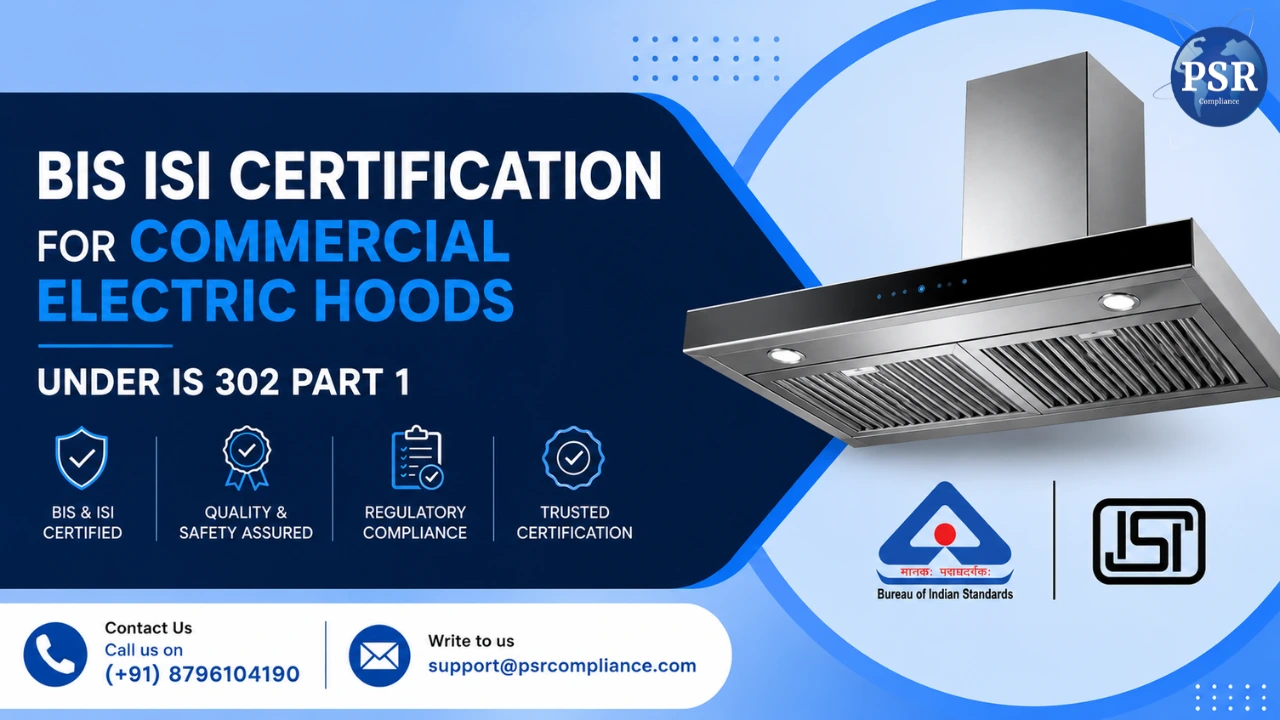
BIS ISI Certification for Commercial Electric Hoods Under IS 302 (Part 1): 2024
In a busy commercial kitchen, everyone talks about ovens, fryers, ranges, and cooking machines. But look above the cooking line and you will find one product doing silent work all day: the commercial electric hood. It pulls smoke, steam, heat, grease, and cooking fumes away from the kitchen. Hotels, restaurants, cloud kitchens, food courts, bakeries, canteens, central kitchens, and institutional kitchens depend on these systems every day to maintain a safe and efficient cooking environment.
Under the Quality Control Order (QCO) for household, commercial, and similar electrical appliances, commercial electric hoods are not just kitchen fittings—they are regulated electrical appliances. Covered products must comply with IS 302 (Part 1): 2024 and carry the BIS Standard Mark (ISI Mark) under a valid BIS licence. For general enterprises, compliance becomes mandatory from 1 October 2026, while small and micro enterprises have extended timelines.
Why Commercial Electric Hoods Require BIS Certification
A commercial electric hood contains several electrical components, including motors, fans, switches, wiring, lights, control panels, filters, ducts, and electrical connections. Since it operates directly above cooking equipment where heat, oil, steam, and grease are constantly present, it works in one of the toughest environments found in commercial buildings.
If these products are poorly designed or manufactured, they may cause overheating, electric shock, wiring failures, motor damage, insulation breakdown, short circuits, or even fire hazards. A hood failure can quickly make a commercial kitchen unsafe, interrupt food preparation, reduce staff productivity, and affect business operations. BIS certification confirms that the product meets Indian electrical safety standards and that the manufacturer follows a consistent quality control system.
Who Needs BIS Certification for Commercial Electric Hoods?
This certification is important for:
- Commercial electric hood manufacturers
- Hotel kitchen equipment suppliers
- Restaurant equipment dealers
- Cloud kitchen setup companies
- Food court equipment vendors
- Commercial kitchen consultants
- Importers of kitchen ventilation systems
- Foreign manufacturers exporting to India
- Private-label kitchen equipment brands
- E-commerce sellers of commercial kitchen appliances
- Institutional kitchen suppliers
If your business manufactures, imports, installs, or sells commercial electric hoods in India, reviewing BIS applicability well before the deadline is strongly recommended.
What IS 302 (Part 1): 2024 Covers
IS 302 (Part 1): 2024 specifies the safety requirements for household and commercial electrical appliances, including commercial electric hoods rated up to 250V for single-phase appliances and 415V for other appliances. The standard also covers appliances used in commercial establishments such as restaurants, catering businesses, hotels, and institutional kitchens.
The standard focuses on electrical safety, mechanical construction, insulation, performance, and reliable operation under continuous commercial use. It excludes certain special-purpose industrial and medical equipment but directly applies to commercial kitchen ventilation systems equipped with electrical components.
Quick Reference: Commercial Electric Hood BIS Certification
| Details | Information |
|---|---|
| Product | Commercial Electric Hoods |
| Applicable Standard | IS 302 (Part 1): 2024 |
| Certification Scheme | BIS Product Certification Scheme |
| Certification Mark | BIS Standard Mark (ISI Mark) |
| Compliance Status | Mandatory |
| Governing Ministry | Ministry of Commerce and Industry |
| Major Import Sources | China, European Union, United States |
Testing Requirements Before BIS Certification
Before receiving BIS certification, commercial electric hoods must successfully pass various safety and performance tests. Mandatory evaluations include earth continuity testing, electric strength testing, protection against electric shock, leakage current testing, earthing verification, and functional performance testing.
Depending on the product design, additional tests may include moisture resistance, rust resistance, overload protection, terminal safety, transformer protection, and transient overvoltage testing. These tests ensure the appliance can safely operate in environments exposed to grease, steam, heat, and continuous daily usage.
Why BIS Certification Can Improve Sales
Imagine a cloud kitchen company opening twenty new outlets. During procurement, one supplier only provides pricing, while another offers complete BIS compliance documentation, technical specifications, model information, and certification readiness.
Most professional buyers will naturally prefer the supplier that demonstrates regulatory compliance and product reliability. BIS certification therefore becomes more than a legal requirement—it serves as a competitive advantage that increases buyer confidence, improves tender eligibility, and strengthens long-term business relationships.
Products Covered Under This Certification
Businesses should review all commercial electric hood models within their product portfolio, including:
- Commercial electric hoods
- Kitchen exhaust hoods with electrical components
- Motorized kitchen hoods
- Electric hoods with built-in lighting
- Commercial hoods with electronic control panels
- Imported commercial electric hoods
- Cloud kitchen ventilation systems
- Hotel kitchen hood systems
- Food court ventilation hoods
Each model should be assessed individually because differences in motor capacity, control systems, electrical ratings, and product design may require separate certification planning.
Common Reasons for Certification Delays
Many businesses mistakenly assume that commercial electric hoods are simply fabricated metal products. However, once electrical components such as motors, switches, lighting, and wiring are incorporated, the product falls within the BIS certification framework.
Common causes of delays include treating the product as non-electrical equipment, incomplete motor specifications, missing wiring information, undefined model numbers, weak product labels, missing installation manuals, incomplete technical documentation, importing products before certification planning, and poor preparation for factory inspections.
Documents Required for BIS Certification
To obtain BIS certification, businesses should prepare company registration documents, factory address proof, product specification sheets, model lists, electrical rating details, brand or trademark certificates, manufacturing process flowcharts, quality control plans, testing equipment details, machinery information, product labels, user manuals, installation guides, and safety warning documents.
For commercial electric hoods, installation instructions are particularly important because incorrect installation can affect both electrical safety and overall kitchen performance.
How PSR Compliance Can Help
Navigating the BIS certification process involves product applicability assessment, documentation preparation, model classification, laboratory testing coordination, factory inspection readiness, label verification, manual review, application filing, and responding to BIS queries.
For importers, the process becomes even more challenging because overseas manufacturers are often unfamiliar with Indian regulatory requirements. PSR Compliance provides complete end-to-end BIS certification assistance, helping manufacturers and importers complete the process efficiently while minimizing delays.
Conclusion
Commercial electric hoods play a critical role in maintaining safety, ventilation, and operational efficiency inside professional kitchens. Under the Quality Control Order, they are now mandatory BIS-certified electrical appliances and must comply with IS 302 (Part 1): 2024 before being manufactured, imported, or sold in India.
If commercial electric hoods are part of your product range, now is the right time to review your models, prepare technical documentation, verify product labels, and begin the BIS certification process. Early preparation helps avoid project delays, strengthens buyer confidence, and ensures uninterrupted market access once the regulation becomes fully enforceable.
Get Expert Help with BIS ISI Certification for Commercial Electric Hoods
Need assistance with BIS ISI Certification under IS 302 (Part 1): 2024 for Commercial Electric Hoods? PSR Compliance offers complete end-to-end support—from product applicability assessment and documentation to product testing, factory inspection, BIS application filing, and final licence approval.
👉 Ensure faster approvals, avoid costly compliance delays, and launch your products confidently with expert BIS consultants.
📞 +91 8796104190
📧 support@psrcompliance.com
Frequently Asked Questions (FAQs)
1. Is BIS certification mandatory for commercial electric hoods in India?
Yes. Commercial electric hoods covered under the Quality Control Order (QCO) must comply with IS 302 (Part 1): 2024 and obtain a valid BIS ISI licence before they can be manufactured, imported, or sold in India.
2. Which standard applies to commercial electric hoods?
Commercial electric hoods are regulated under IS 302 (Part 1): 2024, which specifies the safety requirements for household, commercial, and similar electrical appliances.
3. Who needs BIS certification for commercial electric hoods?
The certification applies to Indian manufacturers, foreign manufacturers exporting to India, importers, commercial kitchen equipment suppliers, hotel and restaurant equipment dealers, cloud kitchen setup companies, private-label brands, and e-commerce sellers.
4. What is the implementation date for BIS certification?
For general enterprises, BIS certification becomes mandatory from 1 October 2026. Small and micro enterprises are provided with extended compliance timelines as notified under the Quality Control Order.
5. What tests are performed during BIS certification?
Commercial electric hoods are tested for electrical safety, earth continuity, electric strength, protection against electric shock, leakage current, earthing, functional performance, moisture resistance, and other safety parameters specified in IS 302 (Part 1): 2024.
6. What documents are required for BIS certification?
Applicants generally need company registration documents, factory address proof, product specifications, model list, electrical ratings, manufacturing process details, quality control plan, testing equipment details, machinery list, product labels, installation manuals, user manuals, and safety instructions.
7. Can imported commercial electric hoods be sold without BIS certification?
No. Imported commercial electric hoods covered under the QCO cannot be legally imported or sold in India without obtaining the required BIS certification and ISI Mark.
8. Why should businesses begin the BIS certification process early?
Starting early helps manufacturers and importers complete product testing, documentation, factory inspections, and BIS approvals before the mandatory enforcement date. It also prevents shipment delays, project disruptions, marketplace restrictions, and procurement issues.
9. How can PSR Compliance help with BIS certification?
PSR Compliance provides complete BIS certification support, including product applicability review, documentation preparation, laboratory testing coordination, factory inspection assistance, BIS application filing, query resolution, and end-to-end compliance management for both Indian and foreign manufacturers.
10. Why is BIS certification important for commercial kitchen equipment suppliers?
BIS certification demonstrates product safety, improves buyer confidence, supports participation in commercial projects and institutional tenders, facilitates smoother imports, and strengthens your brand's credibility in the commercial kitchen equipment market.