
Just send us your questions or concerns by starting a new case &
we will give you the help you need. Start Here...
pollution noc
Fri, Dec 26 2025
Raju Karn
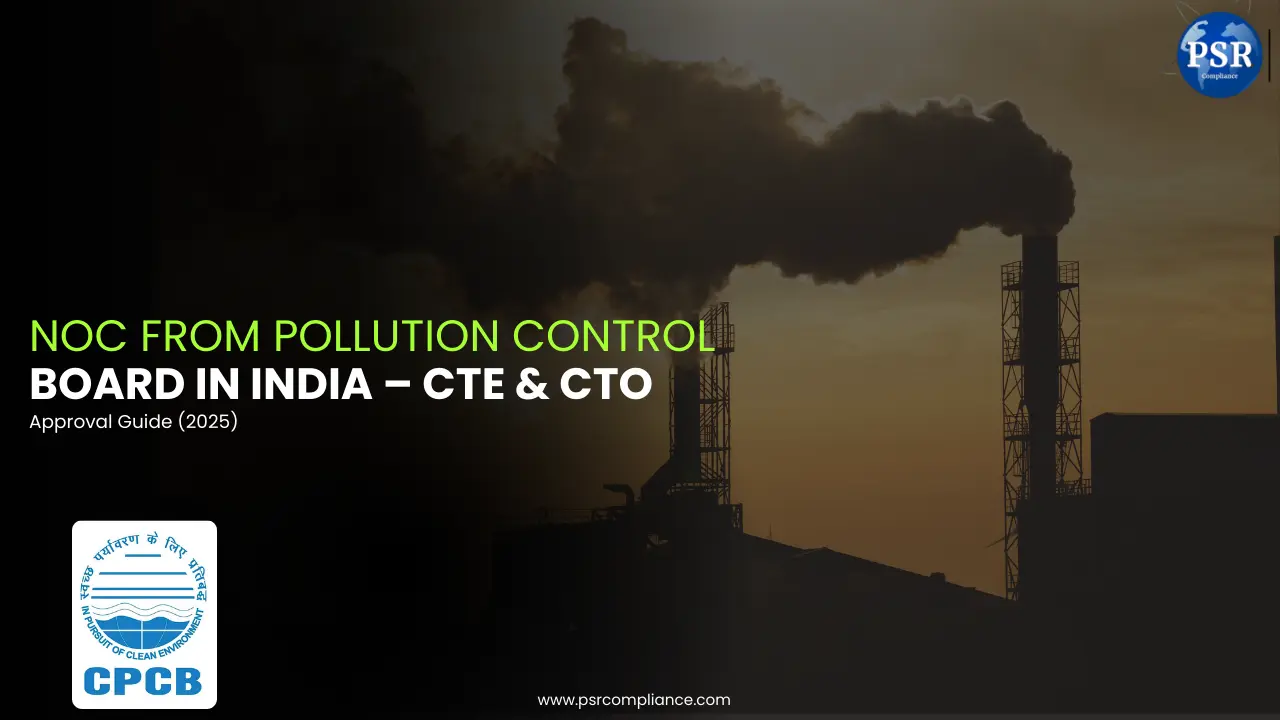
NOC from Pollution Control Board in India – CTE & CTO Approval Guide (2026)
Introduction to NOC from Pollution Control Board
Every industry in India needs a No Objection Certificate(NOC). This certificate must come from the Pollution Control Board (PCB). You must complete it before starting any work.
This helps follow environmental laws like the Water (Prevention and Control of Pollution) Act, 1974. It also includes the Air (Prevention and Control of Pollution) Act, 1981, and the Environment Protection Act, 1986.
The two key approvals required are:
- Consent to Establish (CTE) – Permission to set up the industry.
- Consent to Operate (CTO) – Authorization to begin commercial operations.
Industries that fail to obtain these consents risk heavy fines, legal action, or even shutdowns. This guide explains how to apply for an NOC from the Pollution Control Board. It covers eligibility and why it is important for your business.
What is Consent to Establish (CTE)?
Consent to Establish (CTE) is the initial approval required before constructing or establishing an industrial unit. The State Pollution Control Board (SPCB) or Pollution Control Committee (PCC) grants this permission after assessing potential environmental impacts.
Key Features of CTE
✔ Mandatory for New Industries – Required before land acquisition or construction.
✔ Project-Specific Conditions – May include pollution control measures.
✔ Validity Period – Typically 1 to 5 years, depending on the project.
When Do You Need CTE?
- Before purchasing land for industrial use
- Prior to applying for construction permits
- Before installing machinery or infrastructure
Industries Exempt from CTE
- Small-scale industries with minimal pollution (as classified by SPCB)
- Home-based businesses with no hazardous waste
What is Consent to Operate (CTO)?
Consent to Operate (CTO) is the final clearance needed to start commercial operations. It ensures that the industry complies with pollution control norms before production begins.
Key Features of CTO
✔ Required Before Production – Must be obtained after CTE but before operations.
✔ Renewable Every 5-10 Years – Regular compliance checks are mandatory.
✔ Involves Inspections – The PCB verifies pollution control systems before approval.
Why is CTO Important?
- Legal Requirement – Operating without CTO is a punishable offense.
- Environmental Responsibility – Ensures adherence to sustainable practices.
- Business Reputation – Builds trust with clients and investors.
Industries That Need CTO
- Factories emitting air/water pollutants
- Waste treatment plants
- Large commercial establishments (hospitals, hotels)
NOC from Pollution Control Board (CTE & CTO) – State-wise Guide (2026)
| State | Pollution Control Authority | Key Process Notes |
|---|---|---|
| Delhi | DPCC (Delhi Pollution Control Committee) | Fast online process, strict inspections due to NCR rules |
| Uttar Pradesh | UPPCB (Uttar Pradesh Pollution Control Board) | Large number of applications, moderate approval time |
| Maharashtra | MPCB (Maharashtra Pollution Control Board) | Strict compliance and detailed inspection process |
| Gujarat | GPCB (Gujarat Pollution Control Board) | Smooth online system, strong industrial monitoring |
| Karnataka | KSPCB (Karnataka SPCB) | Balanced approval time with digital application system |
| Tamil Nadu | TNPCB (Tamil Nadu PCB) | Strict document verification and compliance checks |
| West Bengal | WBPCB (West Bengal PCB) | Moderate processing speed through online + regional offices |
| Haryana | HSPCB (Haryana SPCB) | Faster approvals due to NCR proximity |
| Rajasthan | RSPCB (Rajasthan SPCB) | Moderate timelines due to inland industrial setup |
| Punjab | PPCB (Punjab PCB) | Simple application process with moderate inspection time |
Key Differences Between consent to establish and consent to operate
| Aspect | Consent to Establish (CTE) | Consent to Operate (CTO) |
|---|---|---|
| Purpose | Permission to set up the unit | Authorization to begin operations |
| When to Apply | Before construction starts | After setup, before production |
| Validity | 1-5 years | 5-10 years (renewable) |
| Inspections | Not always required | Mandatory before approval |
| Compliance Focus | Project feasibility | Pollution control measures |
Can CTE & CTO Be Applied Together?
Some states allow combined applications, but they grant approvals in phases
Penalties for Non-Compliance
- Fines up to ₹1 lakh per day
- Imprisonment under the Environment Protection Act
- Business closure orders
Industries Requiring NOC from Pollution Control Board
The following businesses must obtain CTE & CTO:
- Manufacturing plants
- Chemical & pharmaceutical units
- Textile & dyeing industries
- Food processing units
- Hospitals & healthcare facilities
- Mining & mineral processing
Red, Orange, Green & White Category Industries
- Red (Highly Polluting) – Requires strict compliance (e.g., chemical plants).
- Orange (Moderate Pollution) – Medium regulation (e.g., food processing).
- Green (Low Pollution) – Simplified process (e.g., small workshops).
- White (Non-Polluting) – NOC not required (e.g., IT firms).
Documents Required for NOC Application
For Consent to Establish (CTE)
- Project report with layout plan
- Land ownership/lease documents
- Water & air pollution control plan
- EIA report (if applicable)
For Consent to Operate (CTO)
- CTE approval copy
- Factory license & industry registration
- Pollution control equipment details
- Environmental compliance audit reports
Additional Documents for HighRisk Industries
- Hazardous waste management plan
- Fire safety clearance
- Effluent treatment plant details
Step-by-Step Application Process
1️⃣ Online Registration
First, you go to your State Pollution Control Board (SPCB) website.
Then you create a new account, just like signing up on any website.
2️⃣ Fill Application Form
Now you fill a form with basic details like:
- What your industry does
- What kind of pollution it may create
- How you will manage waste
Think of it like filling a school admission form, but for your factory.
3️⃣ Upload Documents
Next, you upload important papers like:
- ID proof
- Factory details
- Pollution control plan
These are uploaded online like attaching files in email or WhatsApp.
4️⃣ Pay the Fee
You pay a government fee online.
The amount depends on:
- Size of your industry
- Type of work you do
- State rules
5️⃣ Inspection & Approval
Now government officers may:
- Visit your factory
- Check if everything is safe and clean
If everything is correct, you get approval:
- CTE (Consent to Establish) → before starting the factory
- CTO (Consent to Operate) → after the factory is ready
⏳ This usually takes 30 to 60 days
Timeline for Approval
- 🟢 CTE: 30–45 days (before setting up industry)
- 🟢 CTO: 45–60 days (after inspection)
Common Reasons for Rejection
Your application can get rejected if:
- You forgot to fill some details
- You do not have proper pollution control systems
- You are breaking environmental rules
- You gave wrong or fake information
How to Avoid Rejection?
- Hire an environmental consultant for guidance.
- Conduct a pre-inspection audit.
- Ensure that you submit all documents correctly.
Why is NOC from Pollution Control Board Important?
✔ Legal Compliance – Avoid penalties & shutdowns.
✔ Sustainable Operations – Reduces environmental harm.
✔ Business Credibility – Enhances trust with stakeholders.
✔ Mandatory for Licenses – Required for other permits like fire safety & electricity.
Benefits Beyond Compliance
- Easier bank loan approvals
- Better CSR (Corporate Social Responsibility) image
- Eligibility for government tenders
Conclusion: Ensure Smooth Compliance with Expert Help
Obtaining an NOC from the Pollution Control Board is crucial for legally running an industry in India. The process involves multiple steps, from Consent to Establish (CTE) to Consent to Operate (CTO), with strict compliance checks.
If you need expert assistance in securing your Consent to Operate Certificate or navigating PCB regulations, consulting a PSR Compliance Consultant can streamline approvals and ensure stress-free compliance. Stay legally compliant and grow your business sustainably!
FAQs – NOC from Pollution Control Board in India (CTE & CTO Approval Guide 2026)
1. What is NOC from the Pollution Control Board in India?
NOC from the Pollution Control Board is an official approval issued by State Pollution Control Boards (SPCBs) that allows industries to legally operate while ensuring they comply with environmental pollution control norms under the Air Act, Water Act, and Environmental Protection Act.
2. What is CTE and CTO in Pollution Control Board approval?
CTE (Consent to Establish) is required before setting up any industry, while CTO (Consent to Operate) is required after installation of machinery to legally start operations. Both approvals are mandatory depending on the stage of the business.
3. Is Pollution Control Board NOC mandatory in India?
Yes, it is mandatory for industries that generate air, water, noise, or hazardous waste pollution. Without CTE or CTO approval, a business cannot legally operate or expand manufacturing activities.
4. Who needs CTE and CTO approval from Pollution Control Board?
Manufacturing units, factories, processing plants, chemical industries, food units, hospitals, workshops, and any business generating emissions or waste must obtain CTE and CTO from the respective State Pollution Control Board.
5. What is the difference between CTE and CTO?
CTE is approval to establish an industrial unit, while CTO is permission to run the unit after setup. CTE comes first, and CTO is granted only after inspection and compliance verification.
6. How long does it take to get Pollution Control Board approval?
CTE and CTO approvals generally take 15 to 60 days depending on the industry category (Red, Orange, Green), documentation accuracy, and inspection requirements of the State Pollution Control Board.
7. What documents are required for Pollution Control Board NOC?
Key documents include company registration, site plan, manufacturing process details, water and air pollution control measures, machinery list, ID proof, and waste management plan.
8. Can small businesses or MSMEs apply for PCB NOC?
Yes, MSMEs, startups, and small-scale industries must also apply for CTE and CTO depending on their activity and pollution category classification.
9. What happens if a business operates without Pollution Control Board approval?
Operating without CTE or CTO can lead to heavy penalties, closure notices, factory shutdown, legal action, and cancellation of business operations by authorities.
10. Is Pollution Control Board approval required for expansion of industry?
Yes, any expansion, capacity increase, machinery change, or process modification requires updated approval or amendment in existing CTE/CTO from the Pollution Control Board.
11. How long is CTO (Consent to Operate) valid?
CTO validity depends on industry category. It is generally valid for 1 to 5 years and must be renewed before expiry to continue operations legally.
12. Can Pollution Control Board approval be applied online?
Yes, most State Pollution Control Boards allow online applications for CTE and CTO through their official portals, along with digital document submission and payment.