Wed, Jun 17 2026
Raju Karn
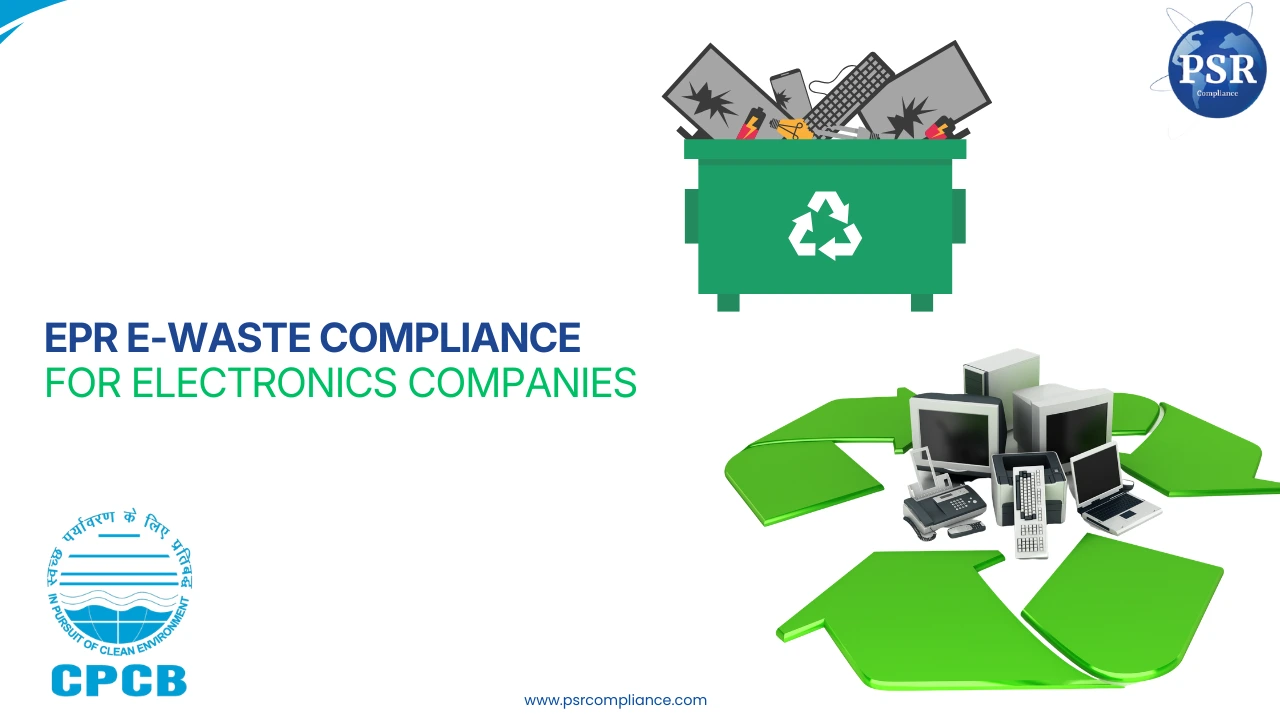
EPR E-Waste Compliance for Electronics Companies
Every time you buy a new phone, television, laptop, or refrigerator, a question arises, what happens to the old one? In India, millions of electronic devices are thrown away every year. Most of them end up in the wrong hands, informal scrap dealers who burn or break them open without any safety measures, releasing dangerous chemicals into the air, soil, and water.
To fix this problem, the Indian government created a rule called Extended Producer Responsibility, or EPR. Simply put, EPR says that the company that makes or sells an electronic product is also responsible for what happens to it at the end of its life. The product does not become someone else's problem the moment it is sold. The producer must bring it back, recycle it safely, and prove they did so.
If you run a consumer electronics company in India or plan to start one, this guide explains everything you need to know about EPR e-waste compliance in simple, clear language.
What Is Extended Producer Responsibility (EPR)?
Extended Producer Responsibility is a legal framework that holds producers, importers, and brand owners responsible for collecting and safely recycling the electronic products they put into the market once those products reach the end of their useful life.
The concept started in Sweden in 1990 and has since been adopted worldwide. In India, EPR for electronics was formally introduced under the E-Waste (Management and Handling) Rules, 2011 and significantly strengthened through the E-Waste (Management) Rules, 2016, which were further amended in 2022 to close compliance gaps and set stricter targets.
In 2022, an estimated 62 million tonnes of e-waste were produced globally, and only about 22% of it was formally collected and recycled. India is one of the largest generators of e-waste in the world, with the country's e-waste surging by 73% in five years. EPR is the government's most powerful tool to bring this under control.
Who Needs EPR E-Waste Compliance For Consumer Electronics?
EPR compliance applies to a wide range of businesses. You need it if you fall into any of the following categories:
Producers
Companies that manufacture electrical and electronic equipment (EEE) listed under Schedule I of the E-Waste Rules. This includes any company that designs, manufactures, or assembles electronics under its own brand name in India.
Importers
Businesses that bring in electronics from other countries for sale in India. Importers of used EEE must ensure 100% recycling for items that are not re-exported.
Brand Owners
Companies whose brand name appears on the product, even if manufacturing is done by a third party.
Refurbishers
Businesses that repair and resell used electronic equipment.
Dealers and Retailers
Sellers who collect e-waste on behalf of producers.
Collection Centers and Recyclers
Businesses that collect, dismantle, or process e-waste must also register and follow the rules.
Which Products Require EPR Compliance?
The E-Waste Management Rules apply to a wide range of Electrical and Electronic Equipment (EEE). Common products include:
| Category | Examples |
|---|---|
| Communication Devices | Mobile phones and smartphones |
| Computing Devices | Laptops, desktops, and computer peripherals (keyboards, mice, monitors) |
| Display Equipment | Televisions and LED/LCD screens |
| Home Appliances | Refrigerators and air conditioners |
| Laundry Equipment | Washing machines and dryers |
| Office Equipment | Printers and scanners |
| Medical Equipment | Medical electronic devices and instruments |
| Lighting Equipment | Electric lamps and LED lights |
| Audio/Video Equipment | Speakers, sound systems, televisions, and related devices |
| Power Storage | Batteries used in electronics |
Note: Basically, if your product runs on electricity, uses a battery, or has electronic circuits, it almost certainly falls under the EPR framework.
Key EPR E-Waste Rules in India
The main law governing e-waste in India is the E-Waste (Management) Rules, 2016, as amended in 2022. Here are the most important requirements:
Registration with CPCB
Every producer, importer, or brand owner must obtain an EPR Authorization from the Central Pollution Control Board (CPCB). Without this registration, a company cannot legally sell electronics in India.
Collection Targets
Producers must collect and recycle a set percentage of the total quantity of electronic equipment they placed in the market in the previous year.
- 60% by Financial Year 2023-24
- 70% by Financial Year 2025-26
- 80% from Financial Year 2027-28 onwards
Channelization through Authorized Recyclers
Collected e-waste must be sent only to recyclers and dismantlers registered with CPCB or the concerned State Pollution Control Board (SPCB). Informal scrap dealers are not allowed.
Annual Returns
Every producer, bulk consumer, dismantler, and recycler must file annual returns in Form-3 with the concerned SPCB on or before June 30 of the following financial year.
Record Keeping
All e-waste handled must be recorded in Form-2 and made available for inspection by CPCB or SPCB at any time.
Awareness and Consumer Information
Producers must inform consumers about hazardous materials in products, safe disposal methods, and collection points. A crossed-out wheeled bin symbol must be printed on products.
How to Achieve Compliance?
Apply for EPR Authorization from CPCB
Submit an application in Form-1 to CPCB. This is mandatory for selling or importing electronics in India.
Set Up a Collection System
You can:
- Create your own take-back or collection system
- Partner with a Producer Responsibility Organization (PRO)
- Use buy-back, exchange, or deposit refund schemes
Maintain Records and File Returns
Maintain Form-2 records and submit Form-3 annual returns before June 30 every year.
Consumer Education and Product Labelling
Display the e-waste symbol and provide toll-free numbers, websites, and drop-off details through packaging and digital platforms.
Data Security (for IT and computing products)
For laptops and storage devices, ensure certified data destruction using ISO-approved methods like shredding or secure wiping.
Benefits of EPR Compliance
Legal Protection
You can legally manufacture, import, and sell electronics in India without regulatory risk.
Better Business Reputation
Compliance builds trust with customers, investors, and international partners.
Access to Global Markets
Many global buyers require EPR compliance as a prerequisite for partnerships.
ESG and Investor Confidence
Strong EPR compliance improves valuation during funding, mergers, or acquisitions.
Circular Economy Contribution
Encourages recyclable design, waste reduction, and sustainable manufacturing.
Job Creation in Recycling Sector
Supports formal recycling industries and improves safety for waste workers.
Post-Approval Requirements
After obtaining EPR Authorization, ongoing compliance includes:
- Maintaining Form-2 records for inspection
- Filing Form-3 annual returns before June 30
- Meeting annual collection targets
- Ensuring e-waste is not mixed with municipal or hazardous waste
- Conducting consumer awareness programs
- Renewing authorizations when required
Penalties for Non-Compliance By Consumer Electronics Sector
Criminal Penalties under the Environment Protection Act, 1986
Non-compliance can lead to imprisonment up to five years, fines up to Rs. 1 lakh, and additional daily fines for continuing violations.
Environmental Compensation (EC)
CPCB and SPCBs may impose financial penalties based on waste volume and duration of non-compliance.
Business Disruption
Authorities can suspend import licenses, seal manufacturing units, or stop sales operations.
Reputational and Financial Damage
Non-compliance negatively impacts investor confidence, ESG ratings, partnerships, and brand reputation.
Final Thoughts
EPR e-waste compliance is not just a legal requirement for consumer electronics companies, it is a long-term business responsibility. India’s electronics industry is expanding rapidly, and so is the volume of electronic waste.
The E-Waste Management Rules clearly define responsibility: if you make it, sell it, or import it, you are responsible for it until the end of its lifecycle.
The good news is that compliance is achievable. With proper CPCB registration, a structured collection system, certified recyclers, and strong record-keeping, any company can meet its EPR obligations and turn compliance into a competitive advantage.
If you are not yet registered for EPR Authorization, now is the right time to act. The rules are becoming stricter, and penalties for non-compliance are significant.
Get Expert Help for EPR E-Waste Compliance Approval
Need assistance with EPR registration, CPCB authorization, e-waste compliance, or setting up your collection and recycling system? PSR Compliance provides complete support for Extended Producer Responsibility (EPR) for consumer electronics businesses in India, including documentation, CPCB filing, PRO tie-ups, and end-to-end compliance management.
👉 Simplify your EPR registration and stay fully compliant with CPCB rules
📞 +91 8796104190
📧 support@psrcompliance.com
FAQs
Is EPR registration required even for small electronics businesses?
Yes. Any producer, importer, or brand owner listed under Schedule I must obtain EPR authorization.
Can we use a third-party PRO for our EPR obligations?
Yes. You can partner with a Producer Responsibility Organization, but CPCB authorization is still mandatory.
What is the minimum recycler fee under the new rules?
India has set a minimum recycler fee of Rs. 22 per kilogram for consumer electronics e-waste.
What happens to data on old devices sent for recycling?
Certified recyclers use ISO-standard methods like shredding and secure wiping to ensure complete data destruction.
Does EPR apply to e-commerce sellers too?
Yes. Online sellers, brand owners, and importers are fully covered under EPR rules.