Tue, Apr 28 2026
Raju Karn
FSSAI Annual Return 2026: Form D1 Deadline & Penalty
Many food business owners believe that once they get their FSSAI license, their job is done. But that’s not completely true. If your business is involved in making, importing, exporting, repacking, or relabelling food products, there is one more important step you must follow every year. This is called FSSAI Annual Return Filing (Form D1).
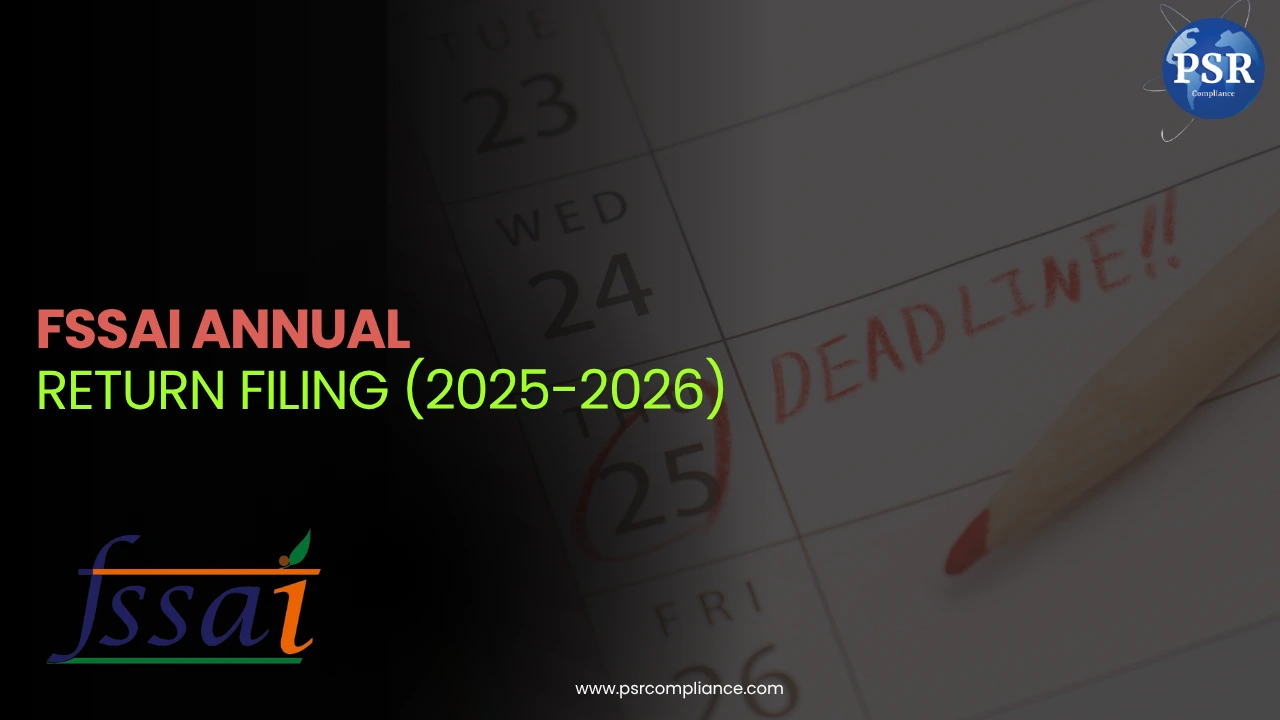
Important Update: Only 1–2 days are left before the 31st May 2026 deadline for filing the annual return.
For the financial year 2025–26, the filing process has already started on the FoSCoS portal, and the last date to complete it is 31st May 2026.
Many business owners miss this step because they simply do not know that it is compulsory. But ignoring it can create problems later, like penalties or trouble in running the business smoothly. That is why every Food Business Operator (FBO) should clearly understand this requirement before starting or continuing their work. In this guide, everything is explained in very simple words so you can easily understand what to do and avoid common mistakes without any confusion.
What is FSSAI Annual Return Filing?
FSSAI Annual Return Filing is a yearly report that some food businesses in India must submit to the government body called the Food Safety and Standards Authority of India. In this report, you share basic details about your food business activities for the whole year. It helps the authority understand what kind of work your business is doing and whether everything is being handled properly as per food safety rules. This return is submitted online through the FoSCoS Portal using a form called Form D1.
In simple terms, this return is like giving a yearly summary of your business to FSSAI. You need to provide details such as:
- What types of food products you dealt with
- How much product you manufactured or imported
- Your sales and distribution details
- Any export or import information
- The category of food products you handle
It’s basically a clear record of your business activities for the year.
Who Needs to File FSSAI Annual Return?
Not everyone with an FSSAI license has to file the annual return. This rule mainly applies to businesses that are directly involved in making or handling food products on a larger level. If your work includes producing, packing, or moving food products across borders, then this filing is important for you. It helps the Food Safety and Standards Authority of India keep track of how food is being produced and sold in the market.
You need to file the FSSAI Annual Return if your business falls into any of these categories:
➜ Manufacturers (people who make food products)
➜ Packers, repackers, or relabellers (those who pack or change labels on food items)
➜ Exporters (especially manufacturer exporters who send food products outside India)
➜ Importers (businesses that bring food products into India)
If your business is involved in any of these activities, then filing this return every year is compulsory.
Quick Applicability Table
| Type of Business | Annual Return Required | Simple Explanation |
|---|---|---|
| Food Manufacturer | Yes | If you make any kind of food product |
| Third-party Manufacturer | Yes | If you get food made from another manufacturer under your brand |
| Repacker | Yes | If you repack food into new packaging |
| Relabeller | Yes | If you change or add labels on food products |
| Importer | Yes | If you bring food products into India |
| Exporter (Manufacturer) | Yes | If you manufacture and export food products |
| Wholesaler / Distributor | No | Only trading, not manufacturing |
| Retail Shop (Kirana / Grocery) | No | Only selling directly to customers |
| Restaurant / Cloud Kitchen | Usually No | Only preparing and serving food |
| Caterer | Usually No | Providing food services for events |
| Transporter | No | Only transporting food |
| Storage / Warehouse | No | Only storing food products |
👉 Important Note:
If a business is involved in both manufacturing and retail (for example, making and selling its own products), then annual return filing is required.
Which Form is Used?
For filing the FSSAI Annual Return, the main form used is Form D1. This is the standard form that most food businesses need to fill every year. If your business is involved in activities like manufacturing, importing, exporting, repacking, or relabelling food products, then this is the form you will use. It is submitted online through the FoSCoS Portal, which is managed by the Food Safety and Standards Authority of India.
Here’s a quick understanding of who uses Form D1:
• Manufacturers
• Importers
• Exporters
• Repackers
• Relabellers
In some special cases, like businesses dealing with milk and milk products, another form (Form D2) may also be required. But for most food businesses, you don’t need to worry about that.
Last Date for Filing
For the financial year 2025–26, the last date to file your FSSAI Annual Return is 31st May 2026. This deadline is set by the Food Safety and Standards Authority of India, and it is very important to follow it on time.
Many people make the mistake of waiting until the last week, which can cause problems. The FoSCoS Portal may become slow, or you might face confusion with documents and details at the last moment.
Simple advice:
➤ Do not wait till the last week
➤ Keep your documents ready in advance
➤ Try to file early to avoid stress and delays
Filing on time helps you stay safe from penalties and last-minute issues.
What Happens If You Do Not File?
Many businesses ignore the annual return because they think it’s not very important. But in reality, skipping this step can lead to serious problems later. The Food Safety and Standards Authority of India keeps track of your compliance, and missing your return can affect your business record.
If you do not file your FSSAI Annual Return, here’s what can happen:
⚠ Late fees may be charged for missing the deadline
⚠ Penalties can be applied, which means extra cost for your business
⚠ Your compliance record becomes weak, which is not good for long-term growth
⚠ License renewal may become difficult in the future
⚠ You may even receive legal notices from authorities
Information Required for Filing
Before you start filling Form D1, it’s a good idea to keep all your business details ready in one place. This will make the process much faster and easier, and you won’t get confused while filling the form on the FoSCoS Portal. The Food Safety and Standards Authority of India expects accurate information, so preparation is very important.
Here are the basic details you should keep ready:
→ FSSAI License Number
→ Business name and address
→ Type/category of food products you deal with
→ Quantity of products manufactured
→ Import and export details (if any)
→ Sales details (how much you sold)
→ Production records
→ Financial year details (for which you are filing)
Step-by-Step Process of FSSAI Annual Return Filing
Filing your annual return is not very difficult if you do it step by step. Just make sure you have your details ready and follow each step carefully on the official FoSCoS Portal, which is managed by the Food Safety and Standards Authority of India.
Step 1: Log in to the FoSCoS Portal
First, open the official FoSCoS website.
Then log in using your FSSAI license number and password.
This is your entry point to start the filing process.
Step 2: Go to Annual Return Option
After logging in, look for the option called “Annual Return” or Form D1.
Click on it to start your return filing.
Step 3: Fill in Your Business Details
Now you need to enter your business information. This includes:
- Your FSSAI license details
- Details of food products you deal with
- How much you manufactured during the year
- Import and export details (if applicable)
Take your time here and enter everything correctly.
Step 4: Check Everything Carefully
Before submitting, review all the details once again.
Even a small mistake can create issues later, so double-check everything like numbers, product details, and dates.
Step 5: Submit the Form
Once you are sure everything is correct, submit the form.
After submission, you will get an acknowledgement receipt.
Keep this receipt safe for your records-it may be useful in the future.
Simple Summary
In short, the process is:
Login → Select Form D1 → Fill details → Check carefully → Submit and save proof
Step-by-Step Filing Process (Simple Table)
| Step | What You Do | Where It Happens |
|---|---|---|
| 1 | Log in to your account | FoSCoS Portal |
| 2 | Select Form D1 (Annual Return) | FoSCoS Portal |
| 3 | Fill in all your business details | You (Applicant) |
| 4 | Check all information carefully | You (Applicant) |
| 5 | Submit the final form | FoSCoS Portal |
Common Mistakes Businesses Make
Many businesses run into trouble not because the process is difficult, but because of small mistakes that could have been avoided. The Food Safety and Standards Authority of India expects accurate and timely reporting, so even small errors can lead to issues later.
Here are the most common mistakes:
✕ Wrong product quantity
Entering incorrect numbers of how much food was made, imported, or sold.
✕ Mismatch in records and return filing
The data in your internal records does not match what you submit in the return.
✕ Incorrect license number
A simple typing mistake in the FSSAI license number, but it can create serious problems.
✕ Last-minute filing
Waiting until the deadline creates stress and increases the chance of errors.
✕ Ignoring the filing requirement
Some businesses wrongly think annual return filing is optional when it is actually mandatory for applicable categories.
✕ No proper review before submission
Not checking the form carefully before submitting often leads to avoidable penalties or corrections later.
Real Life Example
One of our clients, Mr. Amit Mehta, runs a small packaged snacks business in Delhi. Like many food business owners, he was mainly focused on production and sales and believed that once the FSSAI license was obtained, everything else was taken care of. Because of this, he missed filing his FSSAI Annual Return (Form D1) and also did not properly match his production and sales records on the FoSCoS Portal under the rules of the Food Safety and Standards Authority of India.
Later, when he went for license renewal, he faced compliance issues due to missing filings and data mismatches. At that point, he contacted PSR Compliance. Our team reviewed his records, corrected the errors, and filed his pending annual return with accurate details. We also guided him on how to maintain proper records in the future so he does not face the same problem again. After this, his compliance was cleared and his renewal process became smooth.
How PSR Compliance Helps
We help with all important food compliance services, including:
🗸 FSSAI Annual Return Filing
🗸 Form D1 preparation and submission
🗸 Importer and manufacturer compliance support
🗸 FSSAI license renewal assistance
🗸 New FSSAI registration and licensing
🗸 Complete food business compliance guidance
📞 Need help with FSSAI Annual Return Filing before 31st May 2026?
PSR Compliance
D Block, Sector 6, Noida – 201301
📞 8796104190
📧 support@psrcompliance.com
Frequently Asked Questions
1. Who needs to file the FSSAI Annual Return?
All food businesses holding a State or Central FSSAI License must file the annual return if they are involved in:
- Food manufacturing
- Importing food products
- Exporting food products
- Repacking food items
- Relabelling food products
This rule is under the compliance system of the Food Safety and Standards Authority of India.
2. Who is exempt from filing the annual return?
The following food businesses do NOT need to file Form D1:
- Retail shops (grocery/kirana stores)
- Wholesalers and distributors
- Restaurants and food outlets
- Transporters and storage businesses
- Small FBOs with only Basic Registration (turnover below the applicable limit, generally ₹12 lakhs or as per FSSAI rules)
3. What is the due date for FSSAI Annual Return FY 2025–26?
The last date to file Form D1 is:
👉 31st May 2026
It must be filed on time through the official FoSCoS Portal.
4. What is the penalty for late filing?
If you file late, a penalty of ₹100 per day of delay may be charged.
In serious cases of repeated non-compliance, your FSSAI license can also be suspended or cancelled.
5. Is FSSAI Annual Return filing online or offline?
It is completely online. You must file it through the FoSCoS portal using your login credentials.
6. Which form is used for annual return filing?
Most food businesses use:
👉 Form D1
However, dairy-related businesses dealing with milk and milk products may need to file Form D2 in addition to or instead of Form D1, depending on their activity.
7. What information is required in Form D1?
You need to provide:
- Product-wise production details
- Sales and distribution data
- Import/export details (if applicable)
- Raw material usage information
- Business and license details
8. Can I file the annual return after the due date?
Yes, but it will be considered late and penalties will apply. Also, repeated delays may affect your compliance record with FSSAI.
9. Why is FSSAI Annual Return important?
It helps the authority track your business activities and ensures that your food operations are safe and properly recorded. It is a key compliance requirement for licensed food businesses.
10. What is the most important thing to remember for FY 2025–26?
- Due Date: 31st May 2026
- Platform: FoSCoS Portal
- Form: D1 (mainly)
- Penalty: ₹100/day delay