Wed, Jan 21 2026
Raju Karn
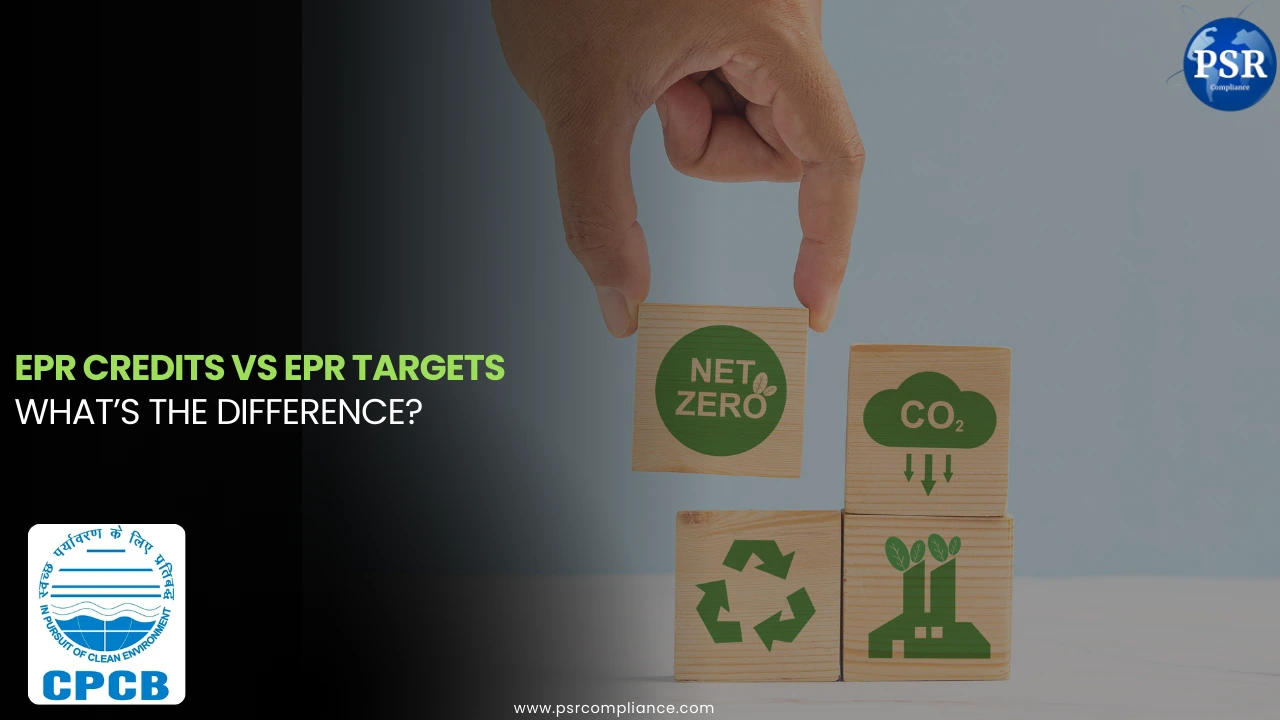
EPR Credits vs EPR Targets: What’s the Difference?
If you are a manufacturer, importer, or brand owner, you must follow EPR (Extended Producer Responsibility) rules.
While doing this, two words confuse almost everyone:
- EPR Targets
- EPR Credits
- They sound similar, but they mean very different things
What Are EPR Targets?
EPR Targets are the responsibility given to your company by CPCB.
In simple words:
👉 EPR target is the amount of waste you must legally manage.
Your target depends on:
- How much product you sell
- The type of waste (plastic, e-waste, battery, tyre)
- Rules notified for that year
Example:
If you sell 1,000 kg of plastic packaging, CPCB may say:
“You must collect and recycle 400 kg of plastic waste.”
That 400 kg is your EPR target.
Why Are EPR Targets Important?
EPR targets are important because:
▪ They decide whether you are compliant or non-compliant
▪ CPCB checks targets every year
▪ Missing targets leads to penalties
Without meeting your target:
▪ Your EPR certificate can be suspended
▪ Your CPCB login may be blocked
▪ Sales and imports may be stopped
What Are EPR Credits?
EPR Credits are the proof that you have met your EPR targets.
In simple words:
👉 EPR credit is the certificate that shows waste has actually been recycled.
These credits are issued by:
• Authorized recyclers
• Registered waste processors
• Registered vehicle scrapping facilities (for ELV)
Each credit represents:
• A fixed quantity of waste recycled
• Verified and uploaded on the CPCB portal
How Do You Get EPR Credits?
You can get EPR credits in two ways:
1️⃣ By Recycling Yourself
If you own:
- A recycling unit
- A processing facility
You can generate your own credits (after CPCB approval).
2️⃣ By Purchasing Credits
Most companies:
- Buy EPR credits from authorized recyclers
- Use them to fulfill their targets
This is legal only if credits are CPCB-approved.
Key Difference Between EPR Targets and EPR Credits
| Point | EPR Targets | EPR Credits |
|---|---|---|
| Meaning | Legal obligation | Proof of compliance |
| Decided by | CPCB rules | Generated by recyclers |
| Based on | Sales & waste generation | Actual recycling |
| Mandatory | Yes | Yes (to meet target) |
| Uploaded on | CPCB portal | CPCB portal |
Simple Way to Understand the Difference
Think of it like this
- EPR Target = Homework assigned
- EPR Credit = Homework submission proof
Without submission, homework is incomplete.
What Happens If Targets Are Not Met?
If EPR targets are not fulfilled:
– Environmental Compensation (EC) is charged
– EPR certificate renewal may be rejected
– CPCB can restrict your business activity
Even if you register on time, targets matter more than paperwork.
Common Mistakes Businesses Make
Many companies think:
➜ Registration is enough
➜ Credits can be adjusted later
➜ Any recycler credit will work
Truth is:
➤ Credits must match waste type
➤ Credits must be within the compliance year
➤ Credits must be CPCB-approved
Why Proper EPR Planning Is Important
Good EPR planning helps:
- Reduce last-minute penalties
- Control credit purchase costs
- Avoid CPCB notices
- Ensure smooth renewal
Businesses that plan early spend less money and less effort.
Confused Between EPR Targets and Credits? Talk to Experts
If you are unsure:
✓️ How much EPR target you have
✓️ How many credits you need
✓️ Whether your credits are valid
PSR Compliance can guide you clearly and honestly.
📞 Call PSR Compliance at 7065883416
A small clarification today can save heavy penalties tomorrow.
FAQs on EPR Target vs EPR Credit
❓ What is the difference between EPR targets and EPR credits?
EPR targets are mandatory recycling obligations calculated by weight for PIBOs, while EPR credits are verified certificates purchased from recyclers to fulfill those targets.
❓ How are EPR targets calculated?
EPR targets are calculated based on the total weight of plastic or waste introduced into the market by a producer, importer, or brand owner.
❓ How are EPR credits generated?
EPR credits are generated by CPCB/SPCB-registered recyclers after verified recycling of waste.
❓ How can EPR credits be used to fulfill EPR targets?
PIBOs purchase EPR credits from authorized recyclers to demonstrate compliance with their annual recycling targets.
❓ Can surplus EPR credits be used for future obligations?
Yes, surplus EPR credits can be carried forward and used for up to two years from the end of the financial year in which they were generated.
❓ What happens if I do not meet my EPR targets?
If EPR targets are not met, PIBOs must purchase the required EPR credits to avoid penalties and regulatory action.
❓ Are EPR credits and carbon credits the same?
No, EPR credits are specific to waste management and recycling compliance, whereas carbon credits relate to greenhouse gas emissions.
❓ Who needs to comply with EPR targets?
Producers, Importers, and Brand Owners (PIBOs) placing regulated waste into the market are required to meet EPR targets.