

Just send us your questions or concerns by starting a new case &
we will give you the help you need. Start Here...
BIS
Tue, Feb 10 2026
Raju Karn
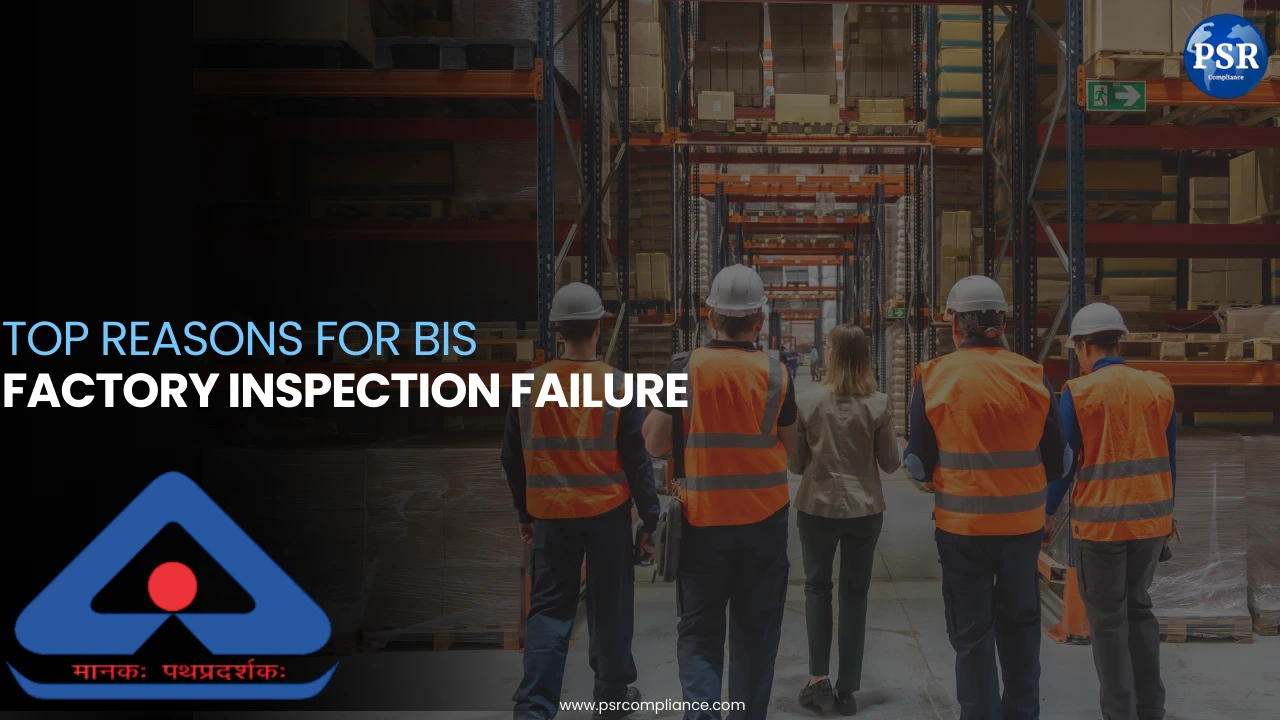
Top Reasons for BIS Certification Factory Inspection Failure
Getting BIS certification helps manufacturers sell regulated products legally and gain trust in the Indian market. However, many factories struggle at one critical stage-the factory inspection. This step checks whether your unit can maintain quality and safety on a daily basis, not just on paper.
Every year, applications get delayed or rejected because factories are not fully prepared for inspection. Missing records, untrained staff, or small setup issues often cause problems. The good news is that most of these issues can be fixed in advance. Understanding what inspectors look for helps you prepare better and clear the inspection without unnecessary delays.
What Is a BIS Factory Inspection?
A BIS factory inspection is a physical verification conducted by BIS officers to check whether a factory can consistently manufacture products as per Indian Standards (IS).
During the inspection, officers verify:
- Manufacturing process
- Raw materials
- Testing facilities
- Quality control system
- Product marking and traceability
The goal is simple: to confirm that the factory can maintain quality, safety, and consistency—not just make one good sample.
Why Factory Inspection Is So Critical
Many manufacturers assume that passing lab testing is enough. That is not true.
BIS certification is based on system compliance, not sample compliance. Even if your product passes lab tests, your license can be rejected if the factory setup is weak or non-compliant.
That is why inspection failure is one of the most common reasons for BIS rejection.
Top Reasons for BIS Certification Factory Inspection Failure
1. Incomplete or Incorrect Manufacturing Setup
One of the most common reasons for failure is an unfinished or unclear manufacturing setup.
Common issues include:
- Missing machines mentioned in application
- Temporary or rented equipment without proof
- Outsourced processes not disclosed
BIS expects the factory to be fully operational at the time of inspection. Any mismatch between documents and ground reality raises red flags.
2. Poor Quality Control System
BIS officers closely examine your quality control process, not just machines.
Failures happen when:
- No defined quality checks exist
- QC records are missing or fake
- Workers do not understand QC steps
If your quality system depends only on experience and not on written procedures, BIS may reject the application.
3. Testing Equipment Not Available or Not Calibrated
For most BIS schemes, in-house testing facilities are mandatory.
Common problems:
- Required testing equipment missing
- Equipment not calibrated
- Calibration certificates expired
- Operators not trained
BIS wants proof that you can test products regularly—not occasionally.
4. Untrained or Unaware Staff
During inspection, BIS officers often speak directly to:
- Production staff
- Quality staff
- Lab technicians
- If staff members cannot explain:
- The production process
- Quality checks
- Test procedures
…it signals poor system control. Even if machines are perfect, untrained staff can cause inspection failure.
5. Incorrect Product Marking and Labeling
Product marking is a serious issue under BIS.
Failures occur due to:
- Wrong IS number
- Incorrect product description
- Missing manufacturer details
- Non-standard marking format
BIS officers physically check marking plates, labels, and packaging. Even a small mistake can lead to objection.
6. Raw Material Traceability Issues
BIS expects manufacturers to maintain raw material traceability.
Inspection fails when:
- Raw material purchase records are missing
- Supplier details are unclear
- No inward inspection records exist
If you cannot prove where your raw materials come from and how they are checked, BIS may question product consistency.
7. Non-Availability of Mandatory Documents
Many factories fail simply due to poor documentation management.
Common missing documents:
- Manufacturing flow chart
- Quality manual
- Test records
- Calibration certificates
- Production logs
BIS inspections are document-heavy. Verbal explanations do not replace written proof.
8. Factory Layout Not Matching Application Details
BIS officers check whether the factory layout submitted in the application matches reality.
Issues include:
- Machines placed differently
- Extra or missing sections
- Shared space with other units
Any major mismatch creates suspicion about operational control.
9. Outsourcing Without Disclosure
Some manufacturers outsource part of the process (like coating, heat treatment, or assembly) but do not disclose it.
This is a serious violation.
BIS may:
- Reject the application
- Ask for a fresh application
- Blacklist the process temporarily
- Transparency is critical during inspection.
10. Poor Housekeeping and Safety Conditions
While BIS is not a safety audit body, basic hygiene and safety still matter.
Negative impressions form when:
- Factory floor is cluttered
- Unsafe wiring or equipment seen
- No basic safety measures present
A poorly maintained factory suggests poor process discipline.
11. Sample Mismatch During Inspection
In some cases, BIS officers collect samples during inspection.
Failure happens when:
- Sample differs from tested product
- Raw materials differ from test batch
- Specifications do not match
Consistency is key. BIS checks whether the tested sample truly represents regular production.
12. Lack of Internal Testing Frequency
BIS expects manufacturers to test products at defined intervals.
Inspection issues arise if:
- No testing schedule exists
- Tests are done only before inspection
- Records look freshly created
BIS officers are trained to identify artificial compliance.
What Happens If You Fail BIS Factory Inspection?
If inspection fails:
● BIS may issue observations
● Application may be put on hold
● Re-inspection may be required
● In serious cases, application is rejected
This leads to:
➜ Extra cost
➜ Loss of time
➜ Missed market opportunities
In some cases, you must restart the entire process.
How to Avoid BIS Inspection Failure
Here are practical steps that actually work:
▸ Prepare factory at least 2–3 weeks in advance
▸ Align documents with actual operations
▸ Train staff on basic BIS questions
▸ Ensure testing equipment is calibrated
▸ Conduct a mock inspection
Preparation matters more than perfection.
Need Help With BIS Certification or Factory Inspection?
PSR Compliance helps manufacturers prepare for BIS inspections and avoid common mistakes that lead to rejection.
📞 Call PSR Compliance: 7065883416
Right guidance. Proper preparation. BIS approval without delays.
FAQs on BIS Factory Inspection Failures
1. Why do BIS factory inspections fail?
Inspections fail due to poor testing facilities, quality system gaps, standard deviations, documentation errors, sample failure, or lack of cooperation.
2. What happens if a BIS inspection fails?
BIS issues a Non-Conformity Report, requests corrective actions, may stop BIS marking, and gives a chance to rectify issues.
3. What is a Non-Conformity Report (NC) in BIS inspections?
It’s a report listing deficiencies as major (critical) or minor, highlighting areas needing correction.
4. How long do manufacturers have to fix inspection issues?
Manufacturers usually have 30 days to submit corrective actions and root cause analysis.
5. Can BIS marking be used after a failed inspection?
No, BIS may order a stop of marking until compliance is verified during re-inspection.
6. What is the rectification process after a failed BIS inspection?
Submit corrective actions, undergo surveillance re-inspection, and retest samples if required.
7. What happens if non-compliance continues after inspection?
License may be suspended, cancelled, or the manufacturer may face blacklisting and legal action under BIS Act 2016.
8. Can a manufacturer reapply after license cancellation?
Yes, but re-application may be restricted if the license was cancelled due to non-conformity.
9. How can BIS inspection failures be avoided?
Conduct pre-inspection audits, maintain calibrated equipment, train staff, and ensure document traceability.
10. Why is sample testing important in BIS inspections?
Failed product samples lead to inspection failure; retesting ensures compliance with safety and performance standards.